The man bringing the news to Ukraine's front-line villages
Each week, Myroshnyk Vassyl Savych heads north to deliver his newspaper to border communities exposed to Russian fire and disinformation.
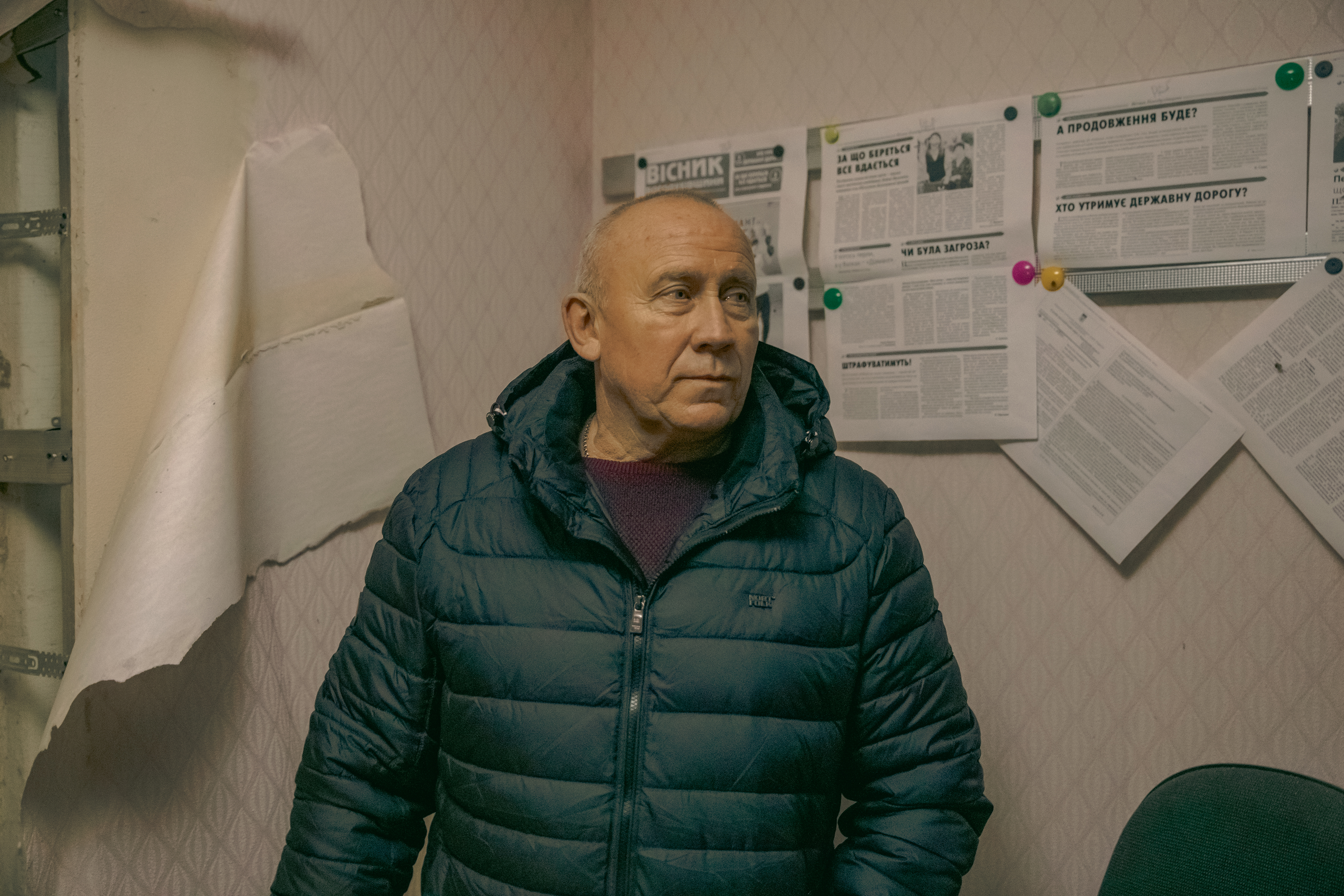
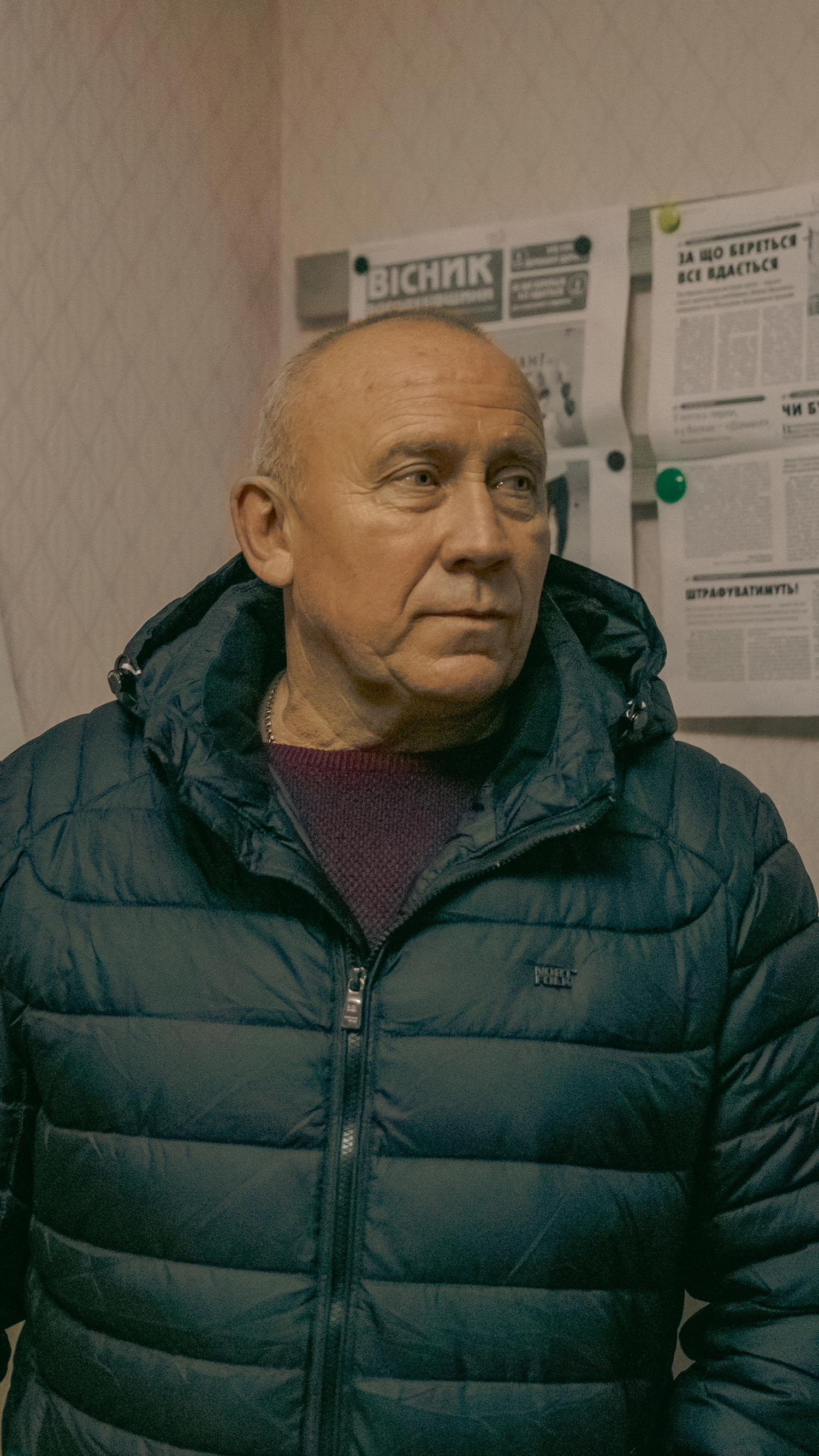
Zolochiv, Ukraine — It’s a cold, foggy morning in early November, and Myroshnyk Vassyl Savych is driving north on a narrow road in eastern Ukraine towards the Russian border. He’s headed to villages where, owing to increasing exposure to Russian fire, only a fraction of residents remain. The war has cut them off from regular services. They no longer receive mail, and Russian transmitters often overpower or interfere with their Ukrainian mobile-phone signals. Before large-scale signal jamming was introduced to counter drones, Russian television and radio channels were accessible on televisions and radios in border-area communities.
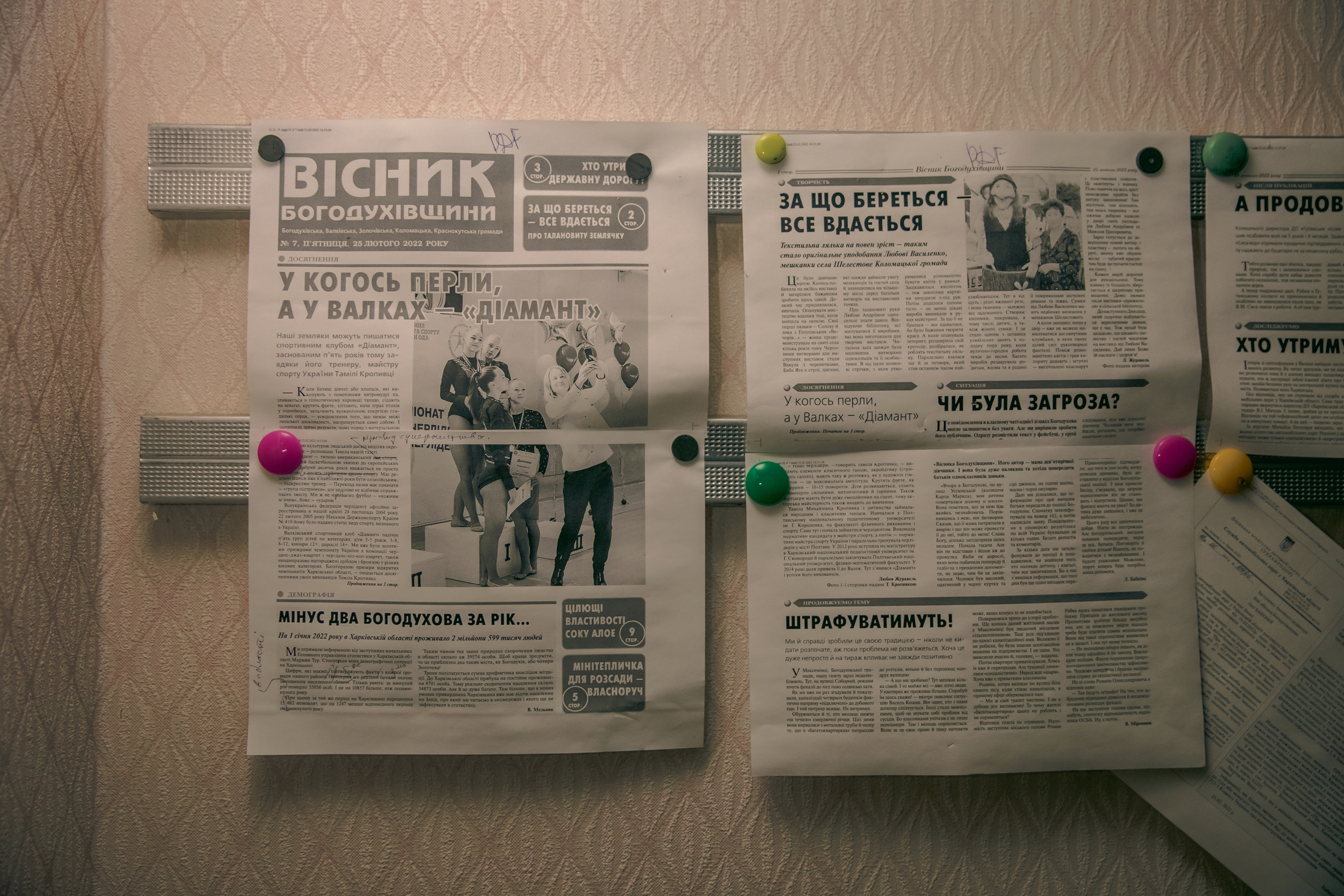
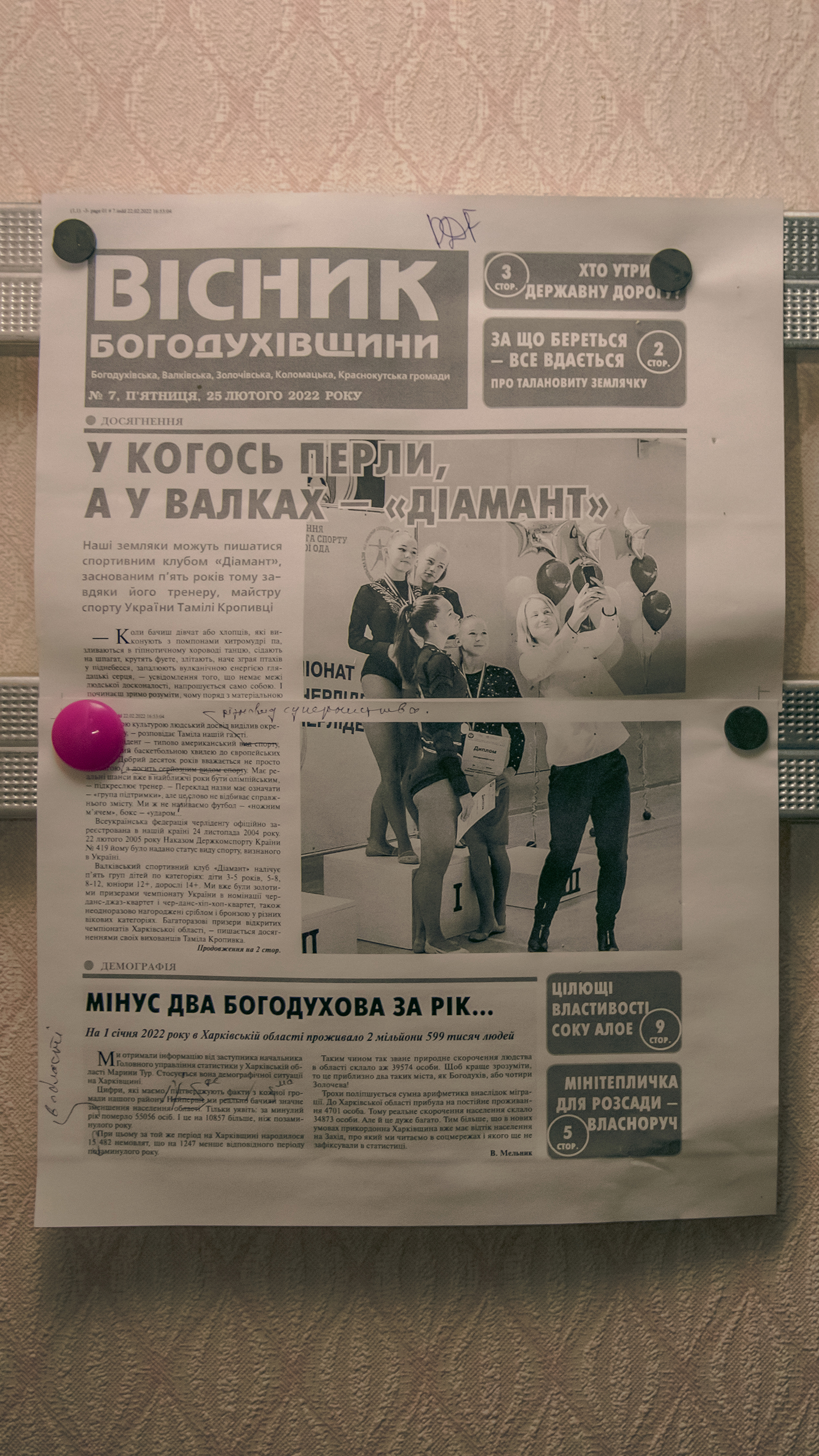
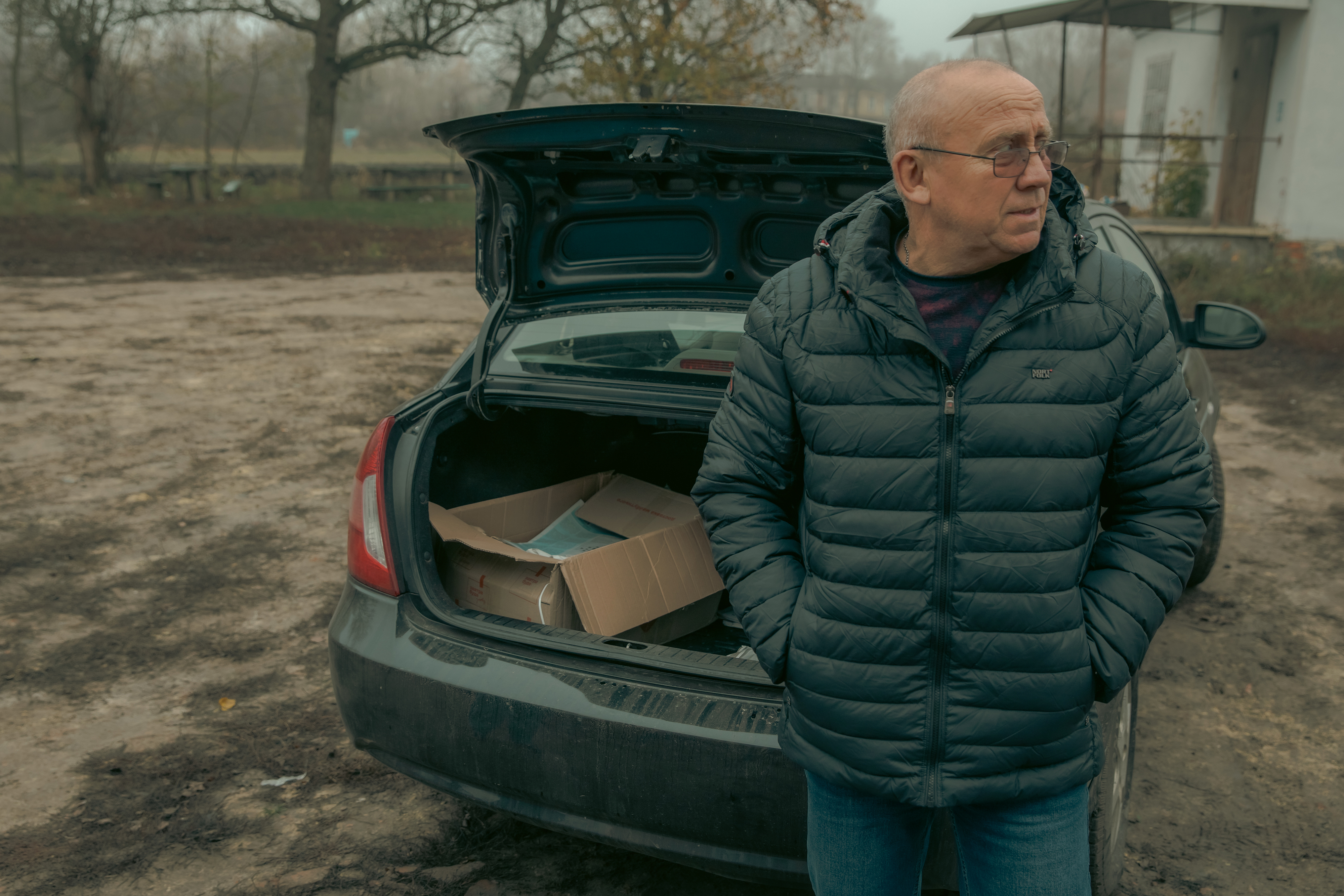
In his trunk are bundles of Zorya Visnyk (The Dawn Bulletin), a local newspaper that Vassyl edits and delivers to front-line communities in Ukraine’s Kharkiv region. The newspaper doesn’t turn a profit, and distribution is dangerous, but Vassyl says it’s often the only reliable source of news that residents get all week.
Having documented the bombing of civilians in his hometown of Zolochiv, also in eastern Ukraine, when the Russian invasion began in February 2022, the editor says he feels compelled to set the record straight, village by village.
“When hospitals or homes are hit, Russian officials claim they were military targets,” he says. “Restoring the truth is our only defence.”
The morning fog reduces visibility to just a few metres on the road ahead, which Vassyl welcomes.
“That’s good for us,” he says reassuringly. “We might not be chased by the drones.”
The asphalt is broken and uneven, having been shredded by artillery strikes, military vehicles and years of neglect. Most drivers avoid this road, but those who don't tend to head south, away from the front line.
Vassyl continues north.
Moving targets
As Vassyl drives, his piercing blue eyes rarely leave the road. A black leather cap covers his bald head, and his imposing build reflects years of physical training. At first, the 65-year-old journalist appears stern and guarded, but when he speaks, his broad smile dispels any sense of intimidation.
In the distance, a muffled blast suddenly rolls through the fog.
“Artillery,” Vassyl says, barely reacting. This sound has been a familiar part of his life for almost four years. Only when a blast is particularly loud does he comment on the type of weapon or whether the explosion is incoming or outgoing.
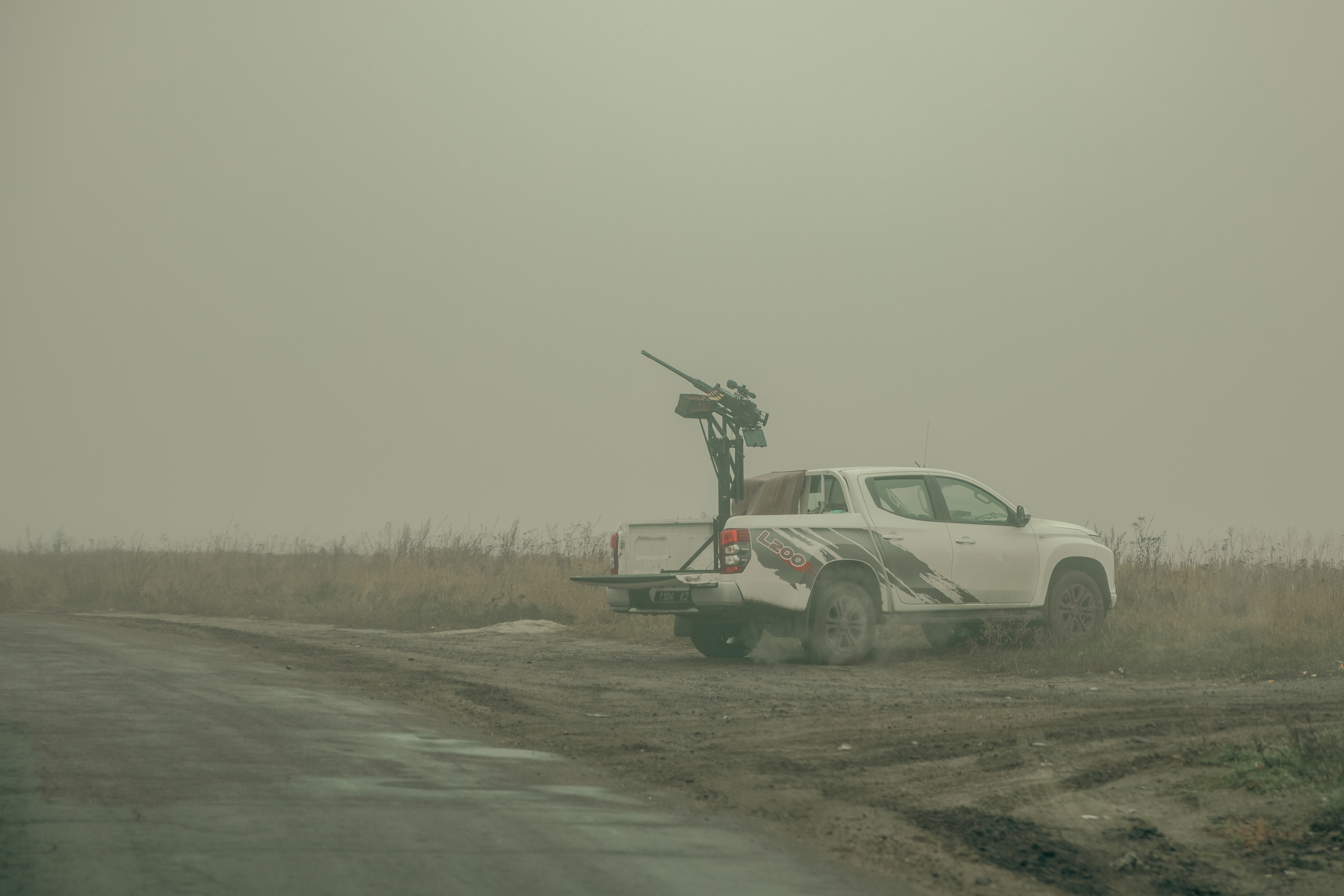
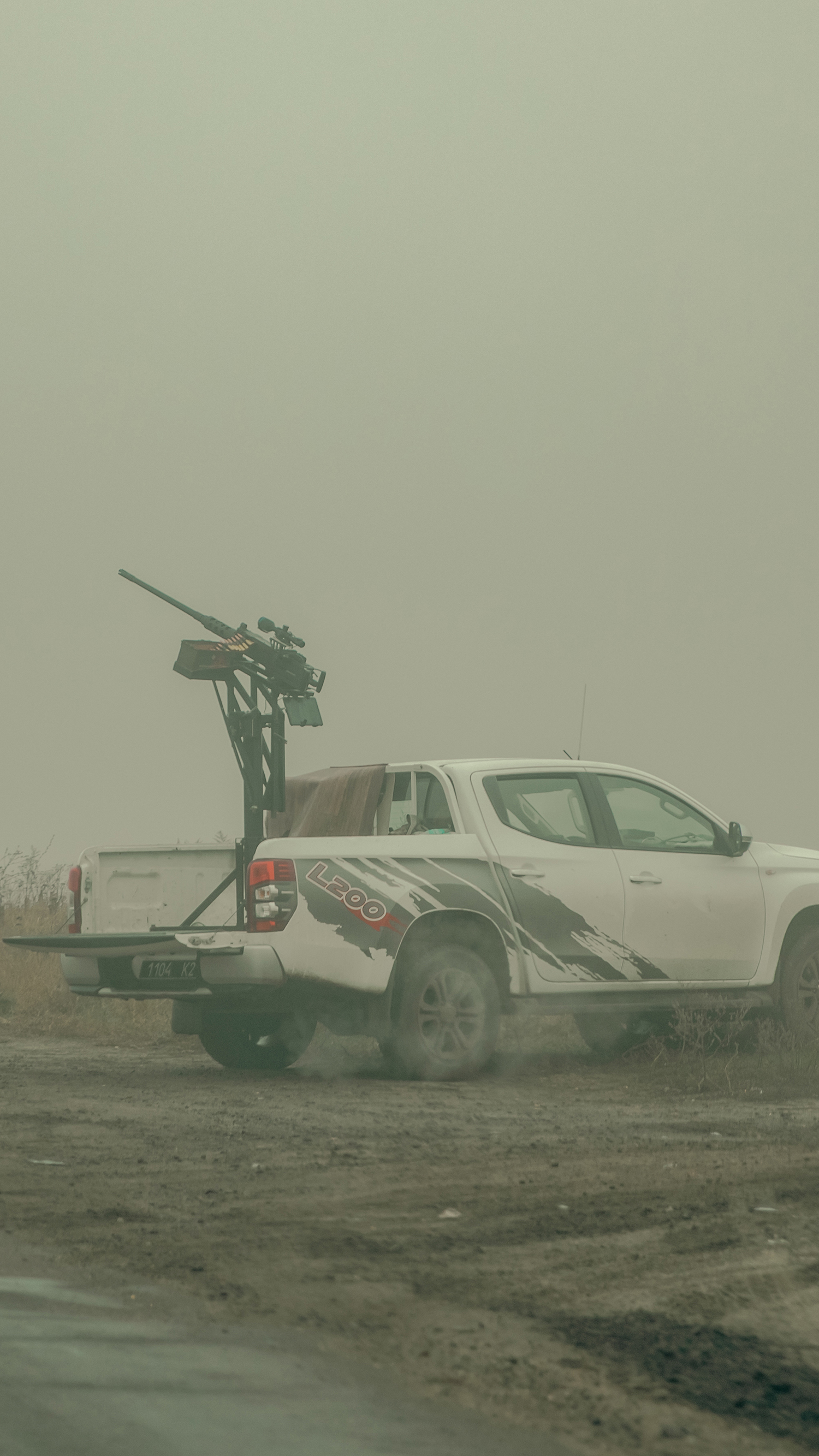
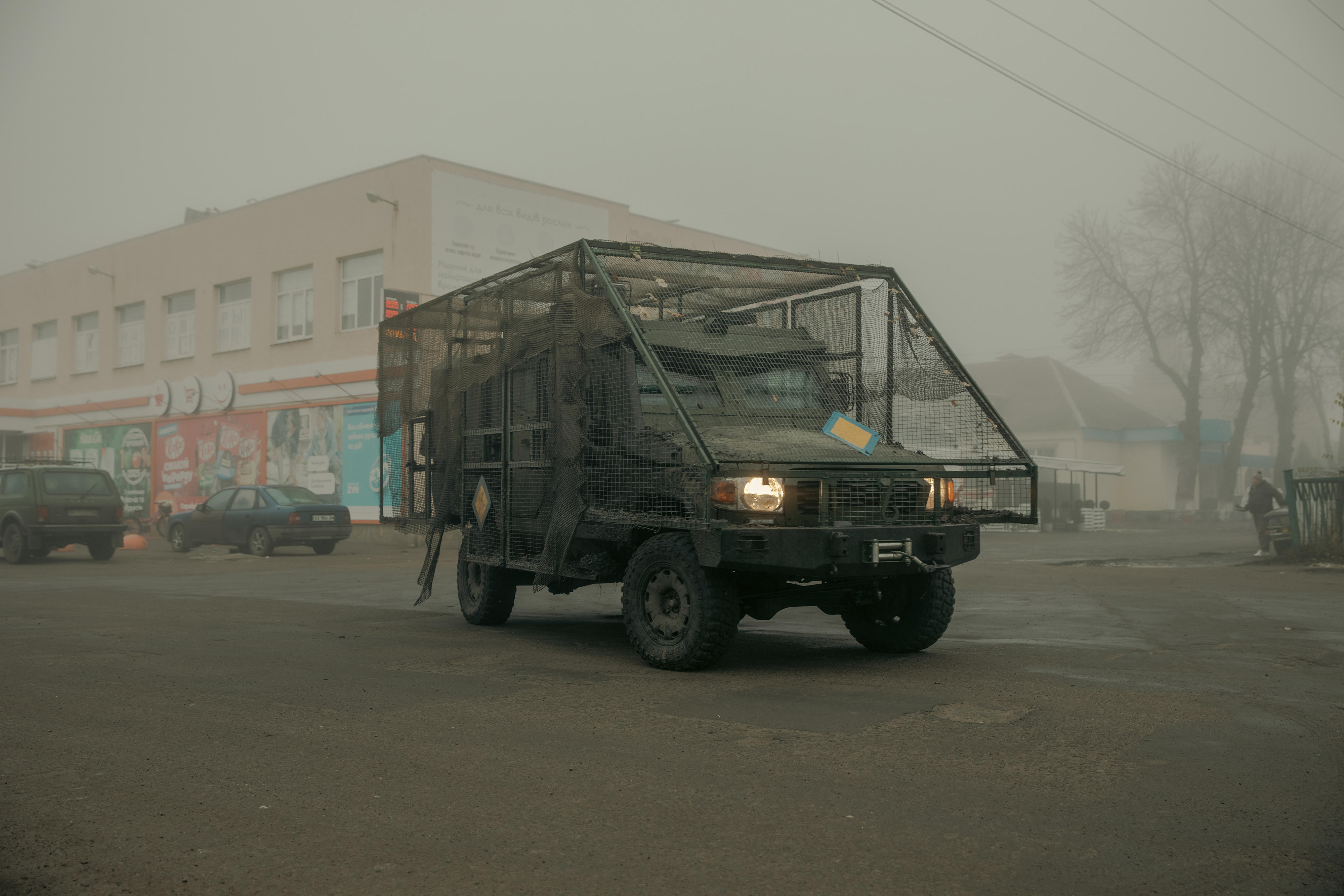
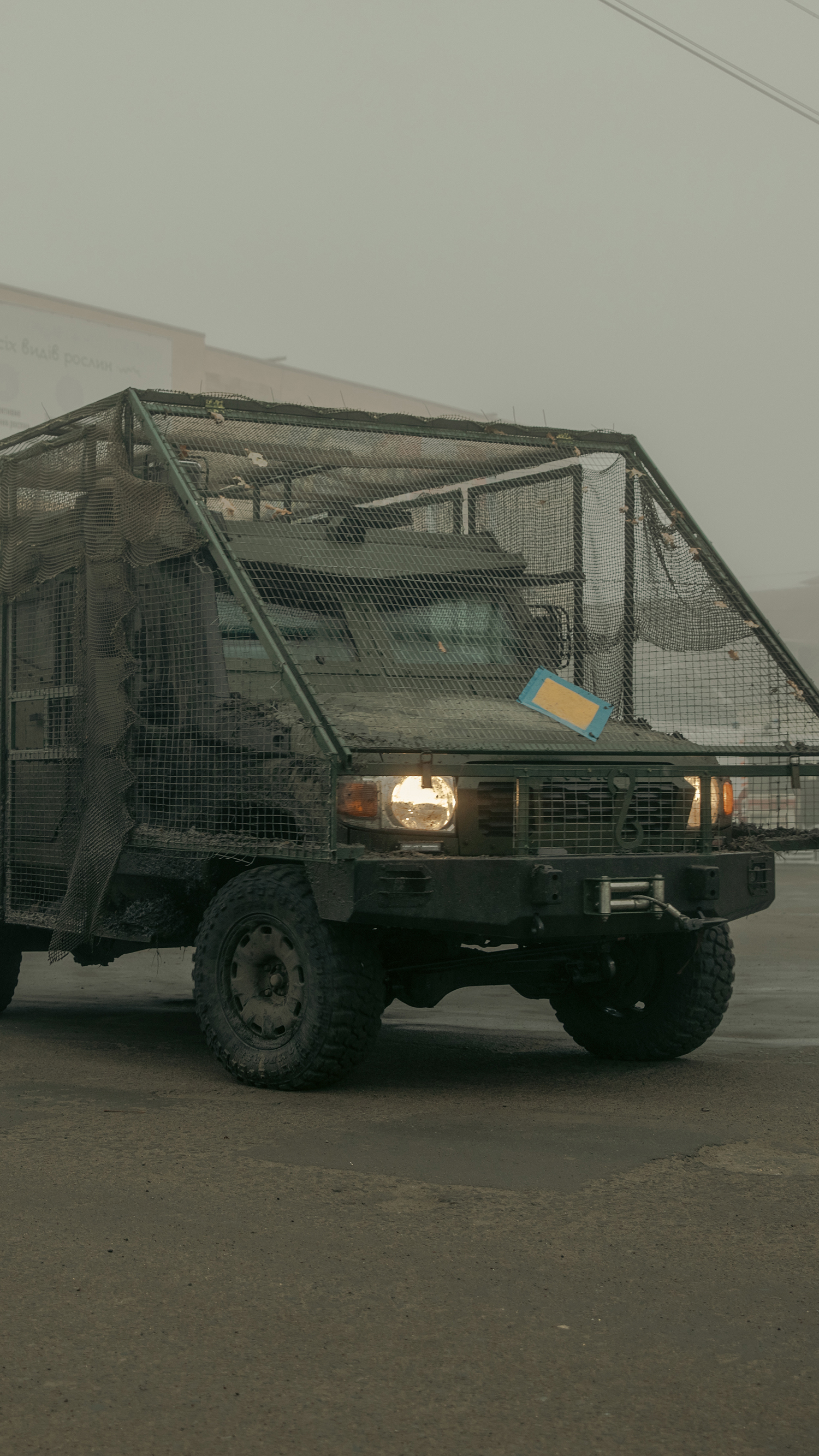
Above the car, nets stretched between wooden poles along the road are meant to shield cars from Russian first-person view (FPV) drones roaming overhead. Installed along the most exposed sections of the road — straight stretches with few trees — the nets are designed to block drones from hitting moving targets.
“I work where anything that moves becomes a target,” Vassyl says, explaining how Russian drone operators treat all sources of movement — vehicles, people, animals — as potential targets.
“We’re now entering a place where you can’t afford mistakes,” he explains. The area is close enough to enemy positions that movement is quickly detected, leaving little room to avoid strikes from artillery, drones, or precision weapons.
Vassyl steadies his car, scans the sky and drives forward. The delivery round has only just begun. Around a dozen villages are on his route today, most of them within range of Russian fire.
A newspaper on Russia’s radar
Before delivering news along the shattered roads of northeastern Ukraine, Vassyl spent years reporting from Zolochiv. He wrote poetry when he was a teenager, studied literature at university in Kharkiv, and joined the local Zolochiv newspaper at age 20. At 31, he stepped away to work for the Ministry of Environmental Protection and Natural Resources, where he investigated corruption in the district. Ten years later, he returned to the weekly.
“I can’t imagine doing anything other than journalism,” he says.
Vassyl is proud that his newspaper was among the first to be de-nationalised in 2017. He helped draft the legislation that allowed Ukrainian local newspapers to be privatised, a step he saw as essential to reducing state pressure and safeguarding editorial independence.
Throughout the war, he has continued to investigate local political corruption, though he acknowledges that much of his focus has shifted to the war.
“Russia feeds on our internal divisions. Even if holding our own authorities to account remains part of the job, currently, my priority is to counter the enemy’s lies,” he says.
The fight against Russian disinformation has put his life at risk more than once.
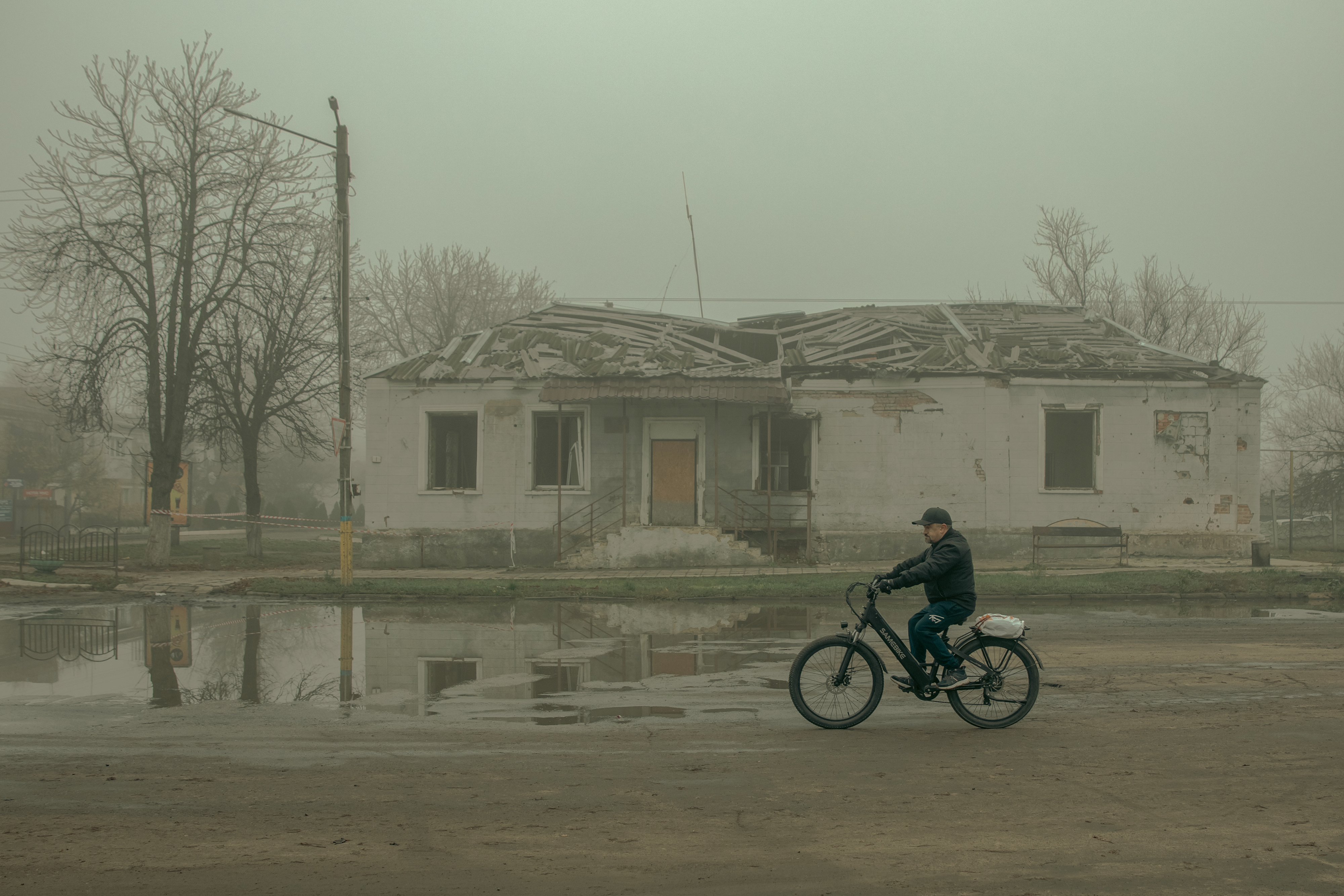
On April 5, 2022, at 9:30am, two Russian shells hit the weekly's newsroom, partially destroying the 140-year-old building that housed it. Vassyl would normally have been sitting at his desk at the time, but he was spared because he stayed in bed longer than usual that day.
“I was running late to work ... The night before, we partied with one of my friends and drank a lot of terrible vodka,” he says with a dark laugh. “It is a time of war. The quality of the alcohol is very bad, but this is all we had.
“That’s what saved me. I usually wake up early, but I was hungover.”
When he finally got moving and was walking with a friend, two shells passed overhead.
"Half a second later, everything exploded.”
Luckily, nobody was in the newsroom at the time. Vassyl’s old desk is still covered in debris more than three years later, and he knows he had a lucky escape.
“Given the shrapnel marks in the room, I would have been dead,” he says.
His newsroom has been targeted 10 times — twice with artillery, eight times with guided aerial bombs — with the latest strike hitting in spring 2025.
At the beginning of the war, Kremlin news outlets claimed that Vassyl was responsible for spreading disinformation.
“Apparently, I run a propaganda outlet,” Vassyl says ironically. “In 2022, Russian state television aired a report accusing me of illegally entering one of their villages to spread false information.
“I have never been there. What I have done, since the start of the war, is document missile remnants embedded in the ground to show where they came from.”
Tracing the origins of missile remnants could expose Russian attacks as war crimes or violations of international law.
“This work is the reason why my newsroom has been targeted,” Vassyl says.
Following the 2022 invasion and the bombing of its printing press in Kharkiv, the newspaper ceased publication for nearly half a year. Russian forces were closing in, prompting many from Zolochiv to flee to safer areas, at least temporarily. But Vassyl chose to remain.
“I had to stay and bear witness, but I couldn't do it if my loved ones were also in danger,” he says, explaining how he sent his family to western Ukraine and then began documenting the destruction engulfing his hometown.
At the time, enemy forces were less than 10km (6.2 miles) away. With his phone, he filmed bombings, civilian evacuations and shattered buildings.
“If I didn’t film what I was seeing with my own eyes, who would have done it? We live in very remote areas. I had to show the world what was happening to us.”
Vassyl taught himself how to edit videos, which he posted on YouTube and social media to reach more people.
“The Russians were claiming they were striking command posts or tank repair facilities,” he says, still outraged. “In reality, they were hitting residential buildings, the hospital and a kindergarten.”
When the Ukrainian army began liberating the first villages near Zolochiv, Vassyl became determined to restore access to news in areas that had been deprived of it for six months. He found a new printing press and got to work.
“In these rural areas, there is often no alternative source for reliable information. People trust us, and we cannot walk away from that,” he says proudly.
Two members of the newsroom returned to work remotely, while Kostyantyn Neoneta, the newspaper’s accountant, remained in Zolochiv like Vassyl.
“I didn’t want to leave,” says Kostyantyn, who distributes the newspaper in the town every week by bicycle. “I knew I was far more useful here than in other cities.”
In those villages where Russian signals bleed into people’s homes, “people are left with propaganda,” Vassyl says, adding, “My mission is to make sure it does not happen.”
The language battlefield
Vassyl also sees language as a key part of resistance. The newspaper is published exclusively in Ukrainian, in a region where Russian remains the dominant language.
“Some people live so close to Russia that questions of identity are deeply entangled,” he explains. “They are more exposed to lies portraying the Ukrainian army as targeting civilians, narratives that risk further deepening divisions within the country.”
To nurture a sense of shared identity, his paper publishes a weekly column called “We Are Ukrainian”, devoted to quiet acts of civic commitment. This week features the story of a retired grandmother who spends her days knitting socks for soldiers.
It also reports on information that few other outlets cover, such as which roads remain drivable and what the local council has decided for the next year’s budget, for example.
The editions in Vassyl’s truck carry a short article explaining how deferral from mobilisation in Ukraine can be obtained online.
Beyond content, the newspaper has been shaped by the war in other ways.
The newsroom now operates from an undisclosed location due to security concerns. Every Thursday, bundles of the four-page paper arrive in the town of Zolochiv via Nova Poshta, a delivery express company. From there, Vassyl loads them into his car and drives to villages no longer served by the postal system due to security concerns.
Since the full-scale invasion began, 333 Ukrainian outlets have closed due to destroyed newsrooms and printing facilities, severed distribution networks, financial pressure and displaced audiences, according to the Kyiv-based Institute of Mass Information.
In the Kharkiv region, Vassyl’s newspaper is among the eight of 35 papers still operating.
The editor and his remaining staff have had to make sacrifices. Vassyl has stopped paying himself a salary, and the staff earn no more than 9,000 hryvnias ($212) a month. The newspaper is funded by Vassyl's personal savings, his family’s income and modest advertising revenue from local authorities.
But these funds barely cover the essentials. Printing now costs more than the selling price, which remains fixed at 15 hryvnias ($0.35).
“People can’t afford more,” Vassyl says. “They still need access to information. So we adjust.”
Still, many of the copies go unsold.
Before the war, 4,000 copies of the newspaper went out every week. Today, it’s not quite half of that. The population has also thinned. Zolochiv once counted close to 20,000 residents, but 12,000 have since fled, and 114 civilians have been killed, according to Vassyl.
Front-line deliveries
Every Thursday, Vassyl gets behind the wheel of his 2005 Renault 4x4 to head north. It’s a car he swears by — inexpensive to repair and capable of handling cratered roads. He says it has carried him into places he might not have made it back from if the car hadn't held up.
Before setting off on this week’s delivery, he pauses in front of his house and nods towards it. “It could vanish at any moment, so I always say goodbye,” he says.
For decades, the house has been the anchor of Vassyl's family life. He has been with his wife for 45 years. This is where their four daughters grew up, where five grandchildren later filled the rooms. As he recalls those peaceful years, his eyes soften.
Once he gets behind the wheel, the stories begin to flow.
He remembers meeting a woman in 2022 in the newly liberated village of Makarove, located around 8km (5 miles) from the Russian border. She was a former nurse who had lived under Russian occupation for six months. She happily took a newspaper from Vassyl, held it to her face to smell the freshly printed pages, and smiled. She hadn’t expected him to come; even the postal service would no longer deliver. The front line was only a couple of kilometres away, and the fighting was intense.
“When the full-scale invasion began, she did not expect her people to be targeted,” Vassyl explains. “They had always lived close to the Russians.”
But in her village of 90, 10 were killed during the occupation.
As Vassyl's car continues north and between villages, the landscape slips into a stillness, broken only by the rough vibration of the scarred asphalt. The war has etched its own geography into Vassyl’s mind.
“When I go out to deliver the newspapers, I'm scared — until I get there,” he says. “Then, you become someone else. You listen, you observe, you feel everything. It's an animalistic hypervigilance. Paradoxically, I love it.”
Fifteen minutes later, he points to a slope along the roadside. That, he explains, is where a drone chased him across the fields for several kilometres not long ago.
“I hate those nets," he says, pointing above. "A few weeks ago, a drone got inside and chased me. I was trapped. Thanks to my Renault, I was able to cut across fields at full speed. I had to drive for miles with a flat tyre,” he recalls.
He survived that episode, just as he survived being fired upon while out delivering newspapers near a Russian helicopter in the early days of the war between Odnorobivka and Ivachky, two villages located just a few hundred metres from the border.
“It used to be just artillery. The usual stuff,” he says, steering around a pothole deep enough to swallow a wheel.
“Now, FPVs are everywhere. They chase cars. They harass and terrify people with the terrible buzzing sound they make. A few days ago, a drone flew into an old woman’s building and followed her up to the second floor, where she tried to hide. She died. That’s what our war looks like now,” he says angrily.
Passing churches along the road, Vassyl makes the sign of the cross, a repeated action that looks almost like a reflex.
“I only started believing after the war began. You realise how little you control, so you pray for protection long enough to finish your mission,” he explains.
Since February 2022, more than 120 journalists have been killed, some while covering the war, others after joining the armed forces. Many other journalists have been wounded. In recent months, targeted attacks against journalists have been on the rise.
Ahead of the car, a loose line of houses materialises through the fog. It is Riasne, the most dangerous village on Vassyl’s route, located just kilometres from the Russian border. One thousand people used to live there. Now there are barely 300.
“A civilian was killed by an FPV in this area just last week,” Vassyl says, cursing the attackers.
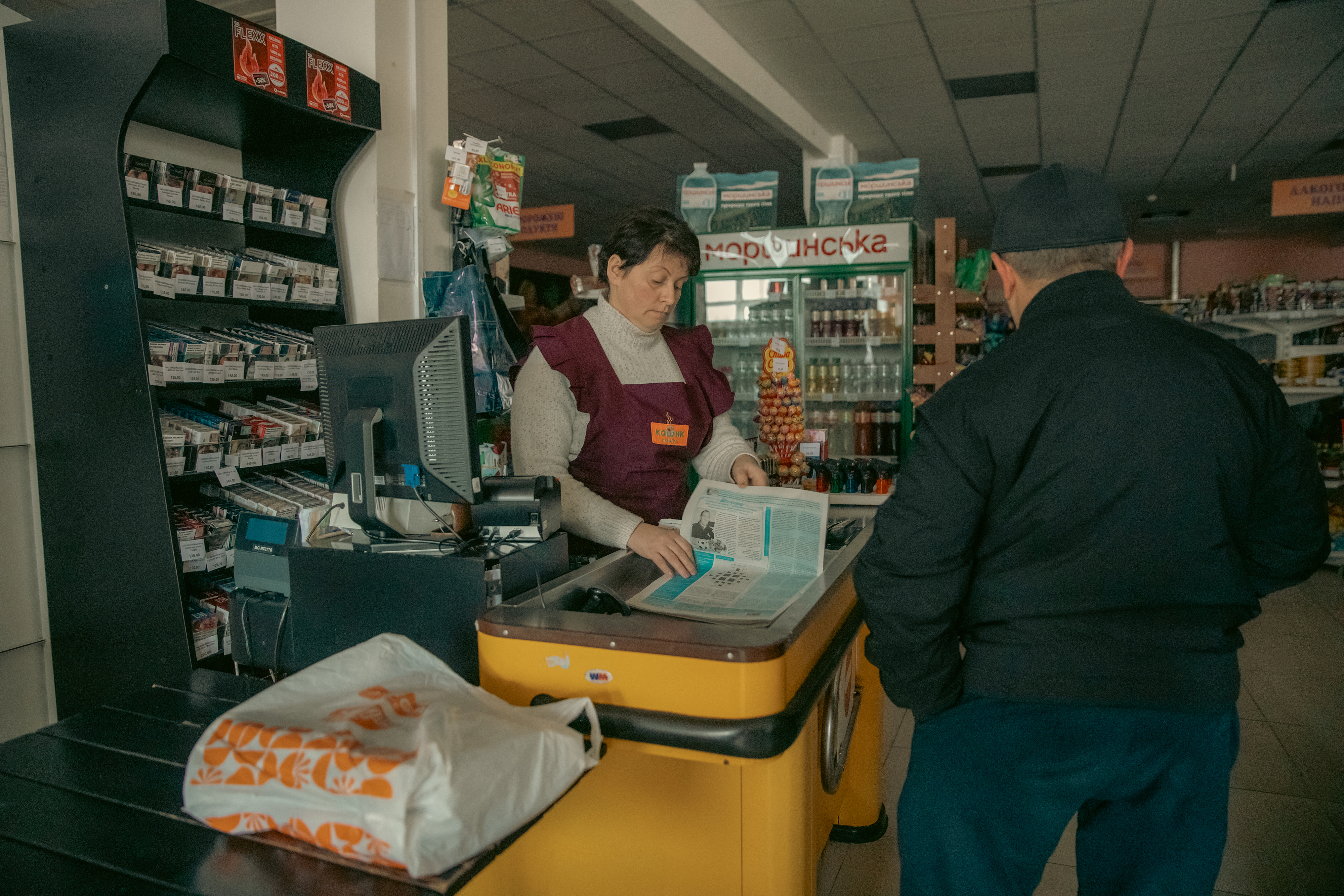
After adjusting his leather hat, he cuts the engine outside the only village shop. He steps out, takes around 40 copies of Zorya Visnyk from the trunk, and goes inside, setting the papers on the counter. He shares a few quiet words with the shopkeeper, gives her a brief smile, then gathers the unsold papers from the previous week.
“There are more every week. People are leaving,” he mutters, glancing up at the sky.
Those who remain in the villages on his delivery route are often elderly residents who refuse to leave, or cannot afford to, with no relatives elsewhere and nowhere to seek refuge.
Outside the almost-abandoned shop, Vassyl gives the empty street a quick look, then gets back behind the wheel. The sound of artillery from large-calibre guns rolls in again. Time to move.
Between the villages, leafless trees punctuate fields alongside the cratered and uneven roads.
Being remembered
During his distribution run, Vassyl encounters a few familiar faces. Many of the women who greet him once worked at post offices that have since closed. Since printing of the paper resumed, these women have helped distribute it in the villages Vassyl visits, taking over once he drops off the bundles.
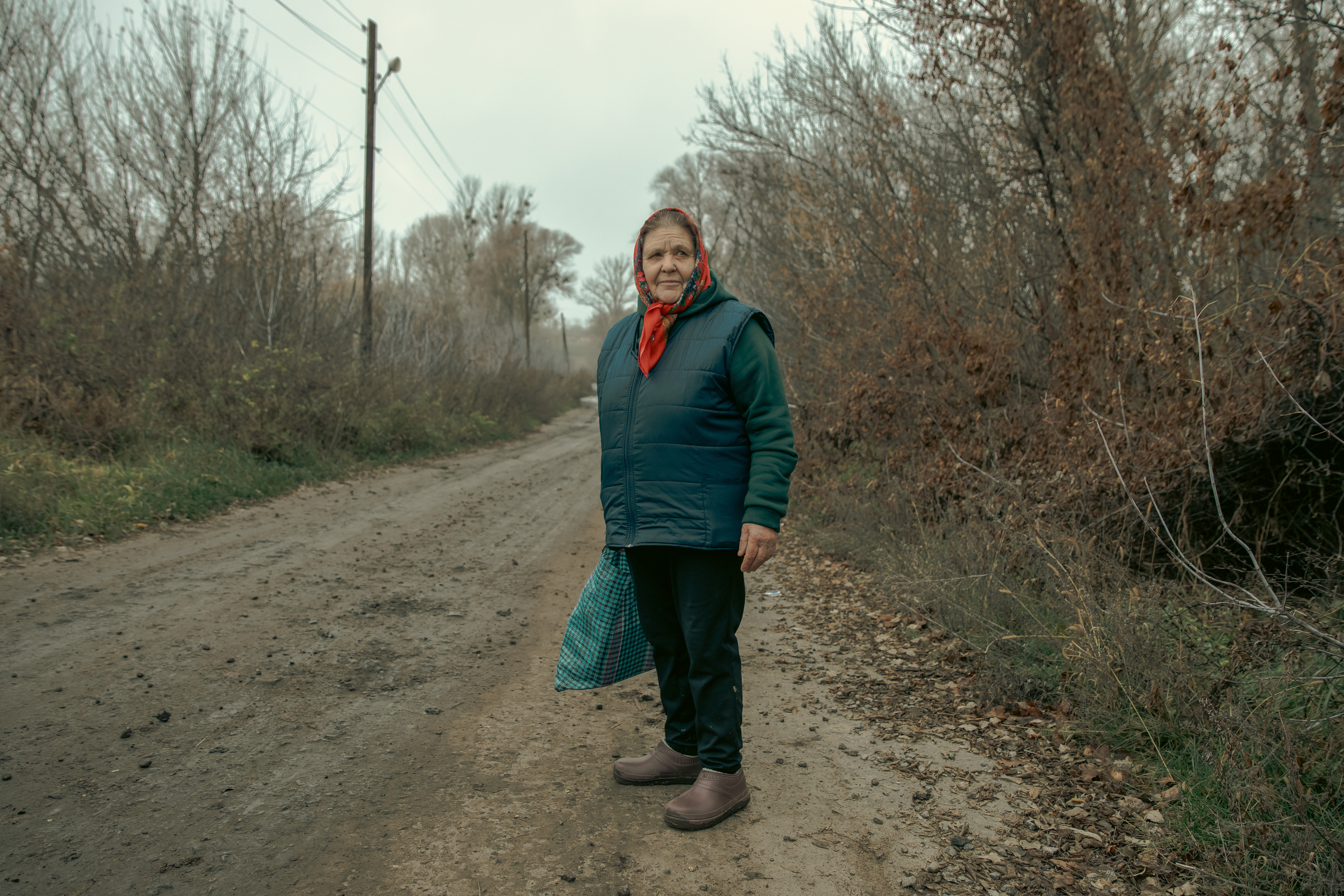
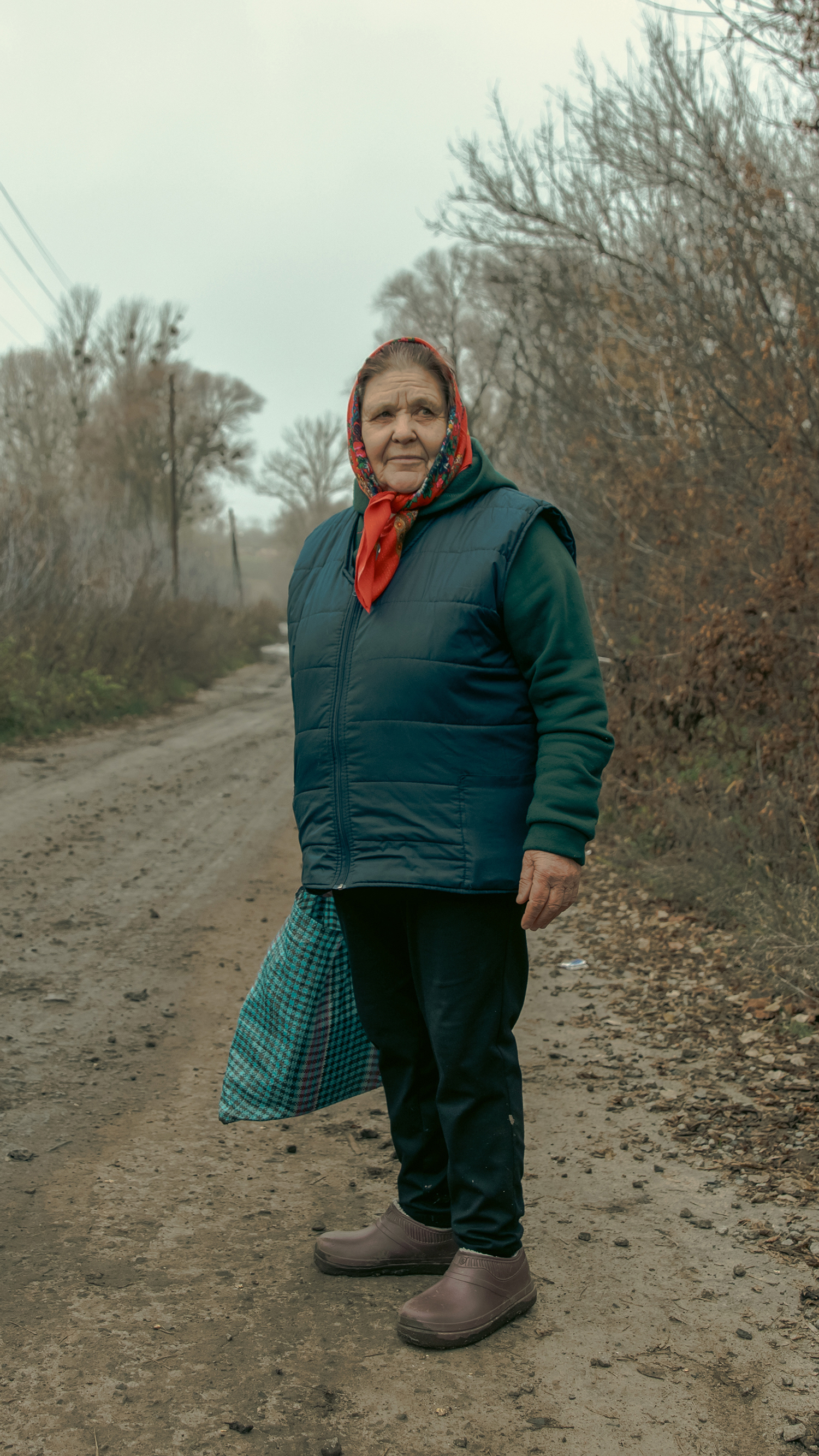
In the small village of Velyka Rohozianka, a woman steps slowly out of the local shop into the fog. Slyvka Nadiia Oleksiivna rearranges her groceries before moving on. She has lived there her entire life and could never imagine being anywhere else.
“To go where?” asks the 75-year-old villager. Many of her neighbours have left. She won’t. “My place is here,” she says.
Her newspaper-reading routine has remained unchanged throughout the war. She always starts with Kalina, the gossip column featuring anonymous submissions sent in by readers. The eagerly anticipated stories are published in two parts, spread over consecutive issues, a strategy Vassyl devised to maintain reader interest and boost sales for much-needed revenue.
Nadiia reads each edition slowly, “so it lasts until the next Saturday, when I collect the newspaper from the shop”.
Almost four years into the conflict, her biggest fear is not shelling or drones, but that the journal might stop reaching the village.
“If the paper still comes, I know things are holding together,” she says with a quiet smile.
In the same village, in front of a small shop that is now the distribution point, Vassyl stops to talk to a man standing beside his bicycle. Volodymyr will celebrate his 79th birthday the following day. It will also be the day he leaves the village for Kharkiv. Attacks against civilians have increased. Staying has become too dangerous.
As the conversation unfolds, the two men break into laughter. Vassyl parts with a broad smile, resting a hand briefly on the man's shoulder.
Back in the car, he is still smiling. Vassyl’s grandmother was Volodymyr’s schoolteacher.
“My grandmother taught him to read,” he says. “Now he reads my newspaper.”
The road eventually drops towards a grey, murky river. It marks one of Vassyl's few recent victories. After he wrote an article about pollution in the water — caused by sewage and other chemicals from factories — authorities opened an investigation in the district of Bohodukhiv.
At the river, he stops the car, gets out, takes out his phone and begins filming. The water is white, owing to pollution. Nothing has changed. Once back at the newsroom, he will commit his observations to print.
Until recently, Vassyl delivered papers to the hamlets pressed right up against the border. But his family and local soldiers insisted that he stop delivering to locations less than a kilometre away from Russia because it made it more likely he would be targeted by FPVs.
Despite his promise to stop, the father of four knows that he will return one day.
“They are waiting for me. When I come, they line up, less for the news than for the fact that someone has come, that someone still remembers them,” he says.
Five more villages still lie ahead. Vassyl starts the engine and drives on.
The next round
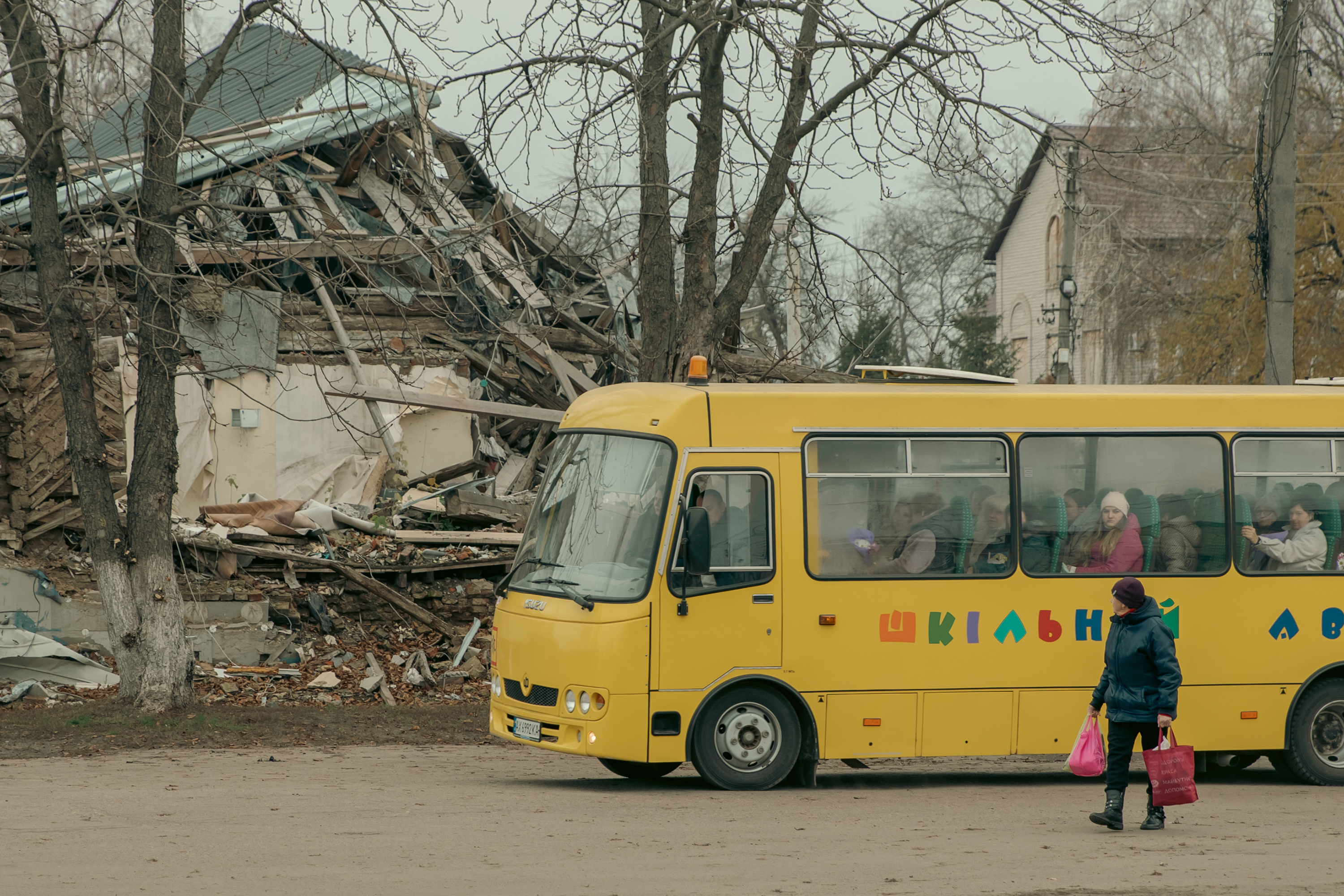
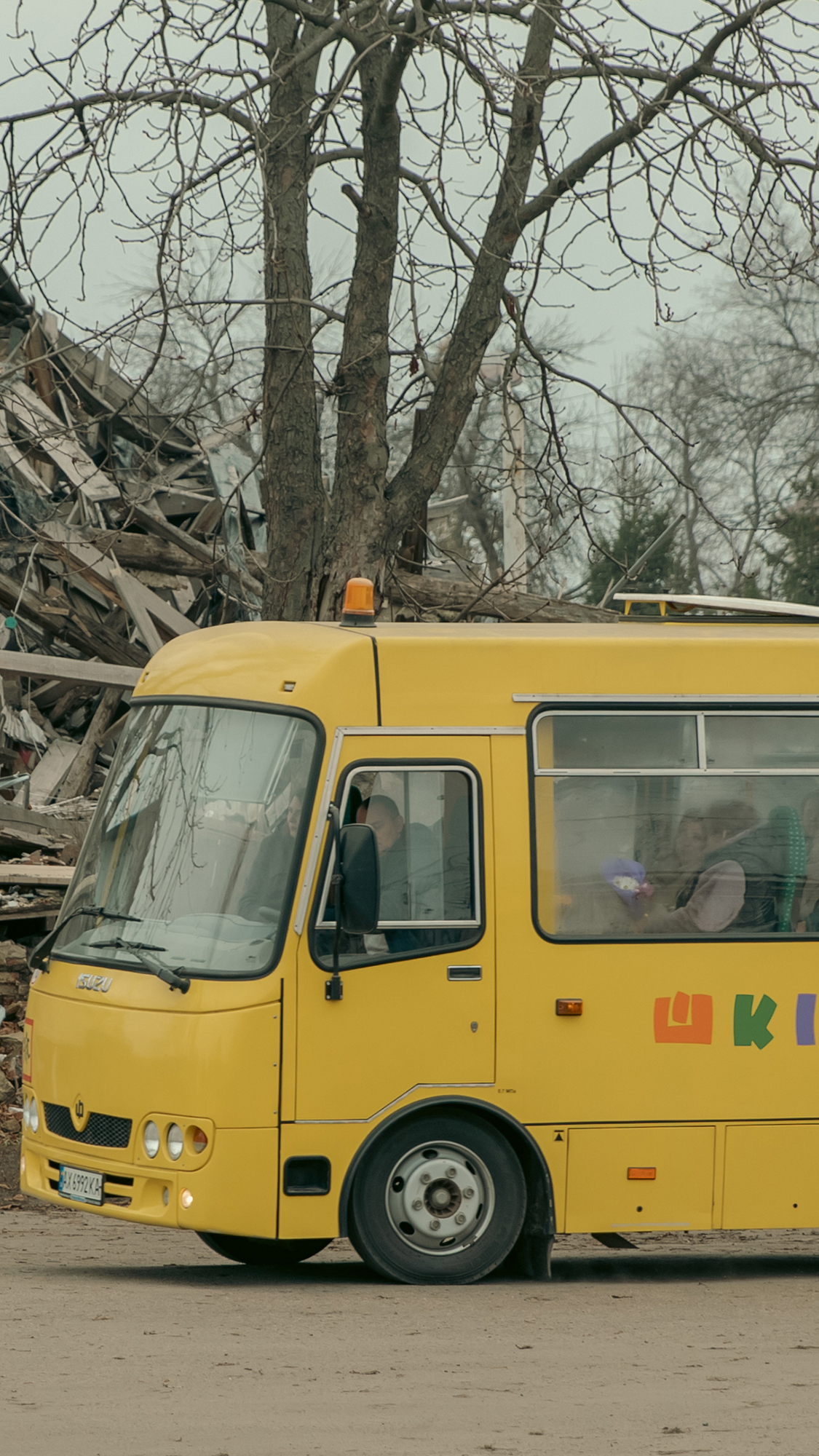
By mid-afternoon, Zolochiv appears again through the windscreen, a haze settling over the town. There are more cars here, compared to the near-barren distribution route, and school buses, now used as public transport for adults instead of children, pull up to the square in the city centre. In this part of northeast Ukraine, children’s classes remain online; the few underground schools that exist cannot serve a region of nearly a million people. A dull explosion rolls somewhere beyond the outskirts, absorbed into the rhythm of the day.
At the square, Kostyantyn arrives on his bicycle, cheeks reddened by the cold. He covers the in-town drop-offs while Vassyl takes the roads no one else wants.
The newspaper run is finished for today.
Vassyl switches off the engine, opens the trunk and lifts out the unsold copies. He turns the pages carefully and tucks the papers under his arm with a gentle, familiar movement.
“I need to finish the investigation about the river,” he says. “That will be published next week.”
The following Thursday, the next edition will arrive in Zolochiv, and Vassyl will again head north. He’ll head back onto roads where civilians are being targeted, his handful of printed pages all that stands between forgotten communities and the silence that threatens to replace them.
“My war is over information. Even after peace is declared, it won’t end,” he says.
“Disinformation will continue, and so will my fight against it.”
