Skip linksSkip to Content
play
Live
Navigation menu
  • News
    • Africa
    • Asia
    • US & Canada
    • Latin America
    • Europe
    • Asia Pacific
  • Middle East
  • Explained
  • Opinion
  • Sport
  • Video
    • Features
    • Economy
    • Human Rights
    • Climate Crisis
    • Investigations
    • Interactives
    • In Pictures
    • Science & Technology
    • Podcasts
    • Travel
play
Live

In Pictures

Gallery|Climate Crisis

The fight to save ‘sacred’ Carpathian forests from loggers
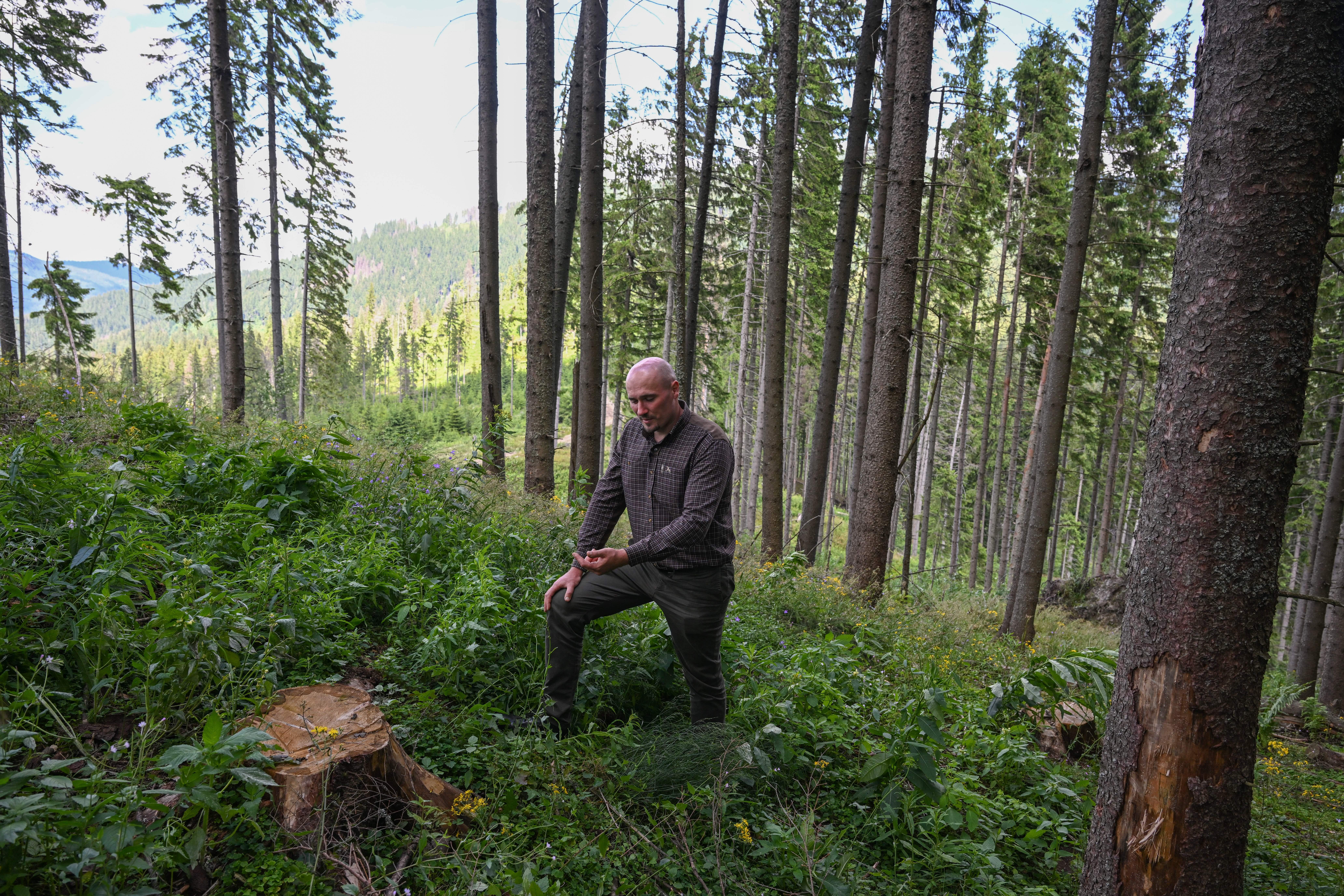
Forest engineer Gabriel Oltean looks for a tree snag marked by him with a digital marker pin
Forest engineer Gabriel Oltean looks for a tree snag marked in a forest in the Tarhaus Valley, near the Ghimes-Faget village in the central Transylvania region of Romania, on July 9 [Daniel Mihailescu/AFP]
By Agence France Presse
Published On 3 Aug 20233 Aug 2023

Share

facebooktwitterwhatsappcopylink

Save

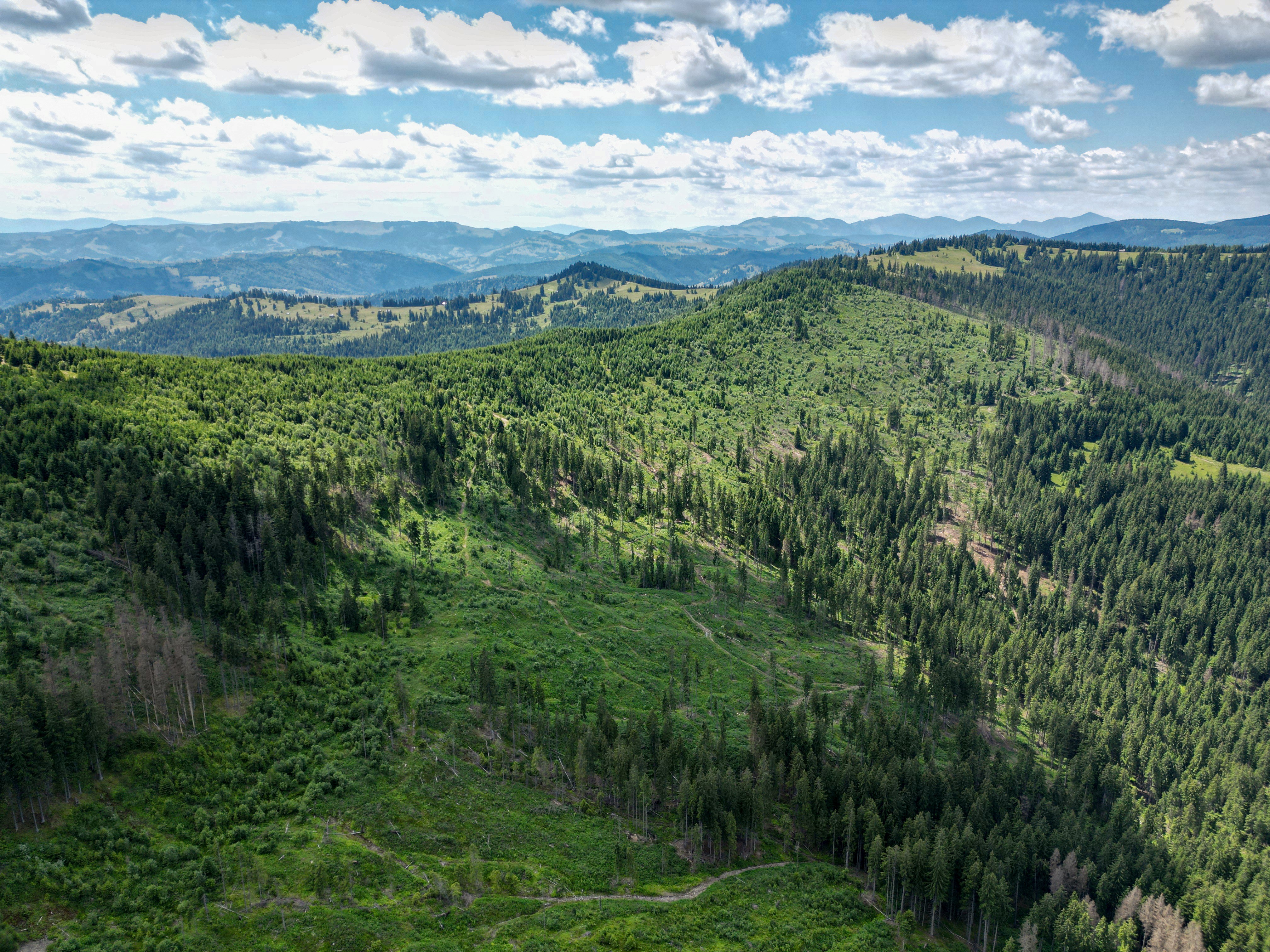
Vast gaps in the forest canopy are visible from above Romania’s Carpathian mountains, while stumps studding the ground are reminders of the trees chopped into logs and piled beside dirt roads.

Forest engineer Gabriel Oltean has fought against this intense, often illegal, logging with cameras that broadcast live on YouTube the incessant passage of woodcutters’ trucks.

He said he caused “a psychological shock” among locals at the gates of the legendary Transylvania region, which led to investigations and wood confiscations – though no criminal convictions yet.

People like him are fighting for forests blanketing the 1,500-kilometre (900-mile) mountain range that spans eight nations and sits in a region that is supposed to be among the best preserved in the European Union.

But in reality, a lack of enforcement and vast profits for the taking mean that the forests’ destruction, while leading to pressure in Romania, is still largely greeted with indifference in Poland.

“This forest should be sacred. We should be protecting such places,” Greenpeace Poland spokesman Marek Jozefiak said in the village of Zatwarnica in the country’s southeast.

“You see that hill? They’ve already logged it. Like 50 metres [160 feet] from a bear den,” said Jozefiak, noting only some 150 brown bears are left in Poland.

One of Europe’s “last remaining biodiversity havens”, the forests covering the Carpathians house bison, lynx, wolves and wildcats, along with many bird species like the three-toed woodpecker or the Ural owl.

Advertisement

On paper, it’s one of the most preserved regions in the EU, but only one to 3 percent of the forest is strictly protected in Poland, according to Greenpeace.

The state forestry agency, responsible for both protecting the forests and cutting the wood, owns the majority of forests.

Its revenue increased by 50 percent in 2022 year-on-year to 15.2 billion zlotys ($3.7bn), 90 percent of which comes from the sale of wood.

The agency is “trying to dig as much money as they can out of it”, Jozefiak said.

In 2018, Europe’s top court ruled that Poland’s government broke the law by logging in Bialowieza, a UNESCO world heritage site that is Europe’s largest surviving primaeval forest.

The old-growth forests of the mountain range are also important for mitigating climate change.

Worldwide, forests absorb a net amount of 7.6 billion tonnes of carbon dioxide, according to a study published in 2021 in the journal Nature Climate Change.

But “on average a forest area of more than five football pitches is lost to wood extraction every single hour” in the Carpathians, Greenpeace said in a report last November.


Spruce trees are pictured in the Tarhaus Valley
Spruce trees are pictured in the Tarhaus Valley, near the Ghimes-Faget village in the central Transylvania region of Romania. [Daniel Mihailescu/AFP]
Advertisement
Flowering plants are pictured in the Tarhaus Valley
Flowering plants are pictured near the village of Ghimes-Faget in the central Transylvania region of Romania. [Daniel Mihailescu/AFP]

Logged wood is seen on a road in the Tarhaus Valley
Logged wood is seen on a road in the central Transylvania region of Romania. [Daniel Mihailescu/AFP]
Logging articulated tractors (TAF) used to handle tree trunks from the forest's steep slopes
Logging articulated tractors used to handle tree trunks from the forest's steep slopes are pictured in the Tarhaus Valley of the central Transylvania region of Romania. [Daniel Mihailescu/AFP]
This aerial view taken on July 9, 2023 shows former logging areas in the Tarhaus Valley
This aerial view taken on July 9, 2023, shows former logging areas in the Tarhaus Valley. The old-growth forests of the mountain range, which span 1,500km (900 miles) across eight Central European nations, are also important for mitigating climate change. [Ionut Iordachescu/AFP]
Ewa Tkacz, Chief forester of the forest division of Stuposiany Bieszczady
Ewa Tkacz, chief forester of the forest division of Stuposiany Bieszczady, poses during an interview. [Janek Skarzynski/AFP]
Advertisement
Logged wood is seen on a road at the Tarhaus Valley
Logged wood is seen on a road near the Ghimes-Faget village in the central Transylvania region of Romania. [Daniel Mihailescu/AFP]
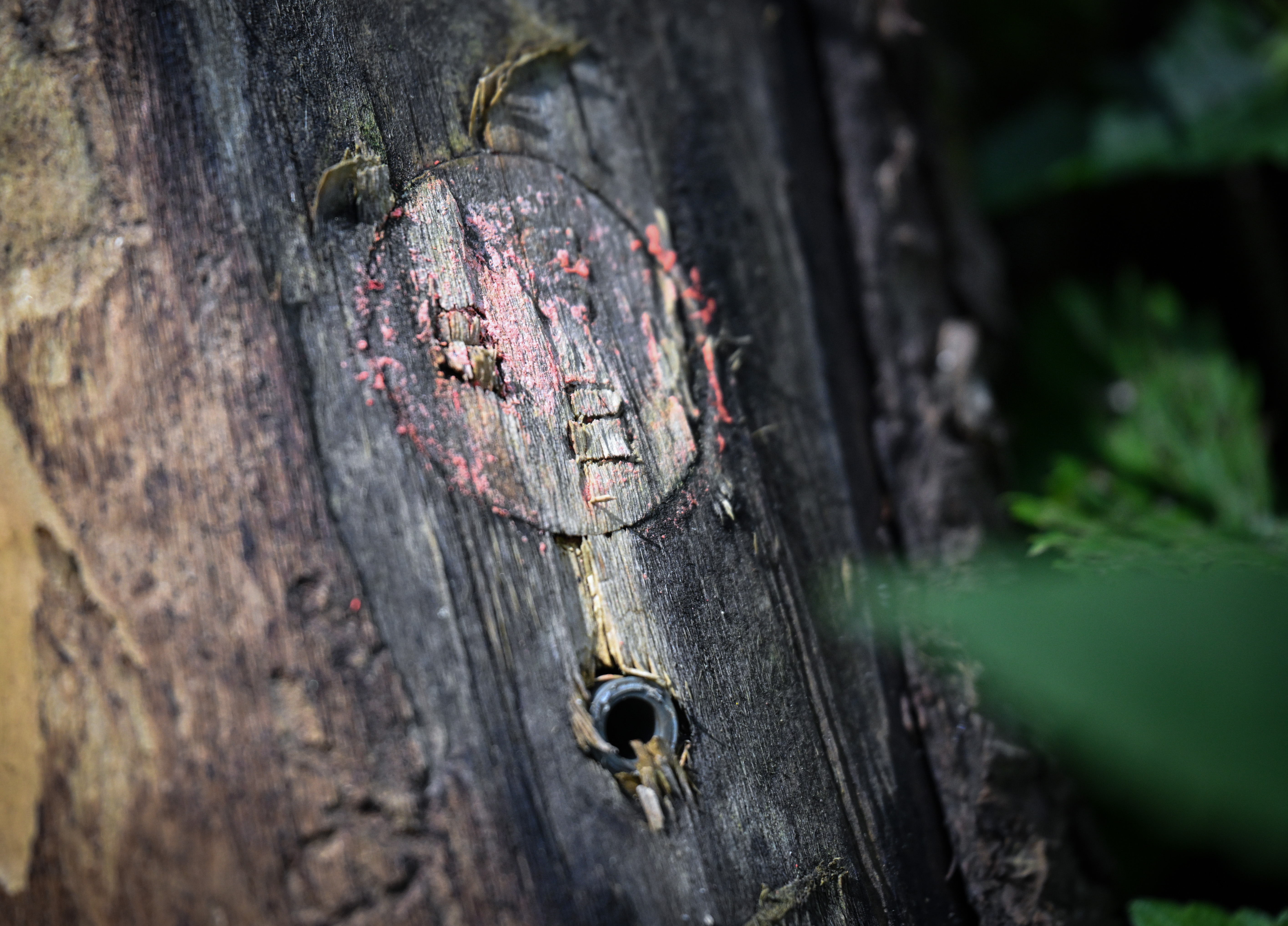
A tree stump (top) and a digital marker pin (bottom) are seen on a tree snag in a forest in the Tarhaus Valley.
A tree stump, top, and a digital marker pin (bottom) are seen on a tree snag in a forest in the Tarhaus Valley, Romania. [Daniel Mihailescu/AFP]
Lumberjacks lift logged trees in a forest in the Bieszczady Mountains
Lumberjacks lift logged trees in a forest in the Bieszczady Mountains that are part of the Outer Eastern Carpathians, Ustrzyki Gorne, southeastern Poland in June. [File: Janek Skarzynski/AFP]
A bug is pictured on a spontaneous flora in the Tarhaus Valley
A bug is pictured on flora in the Tarhaus Valley, near the Ghimes-Faget village in the central Transylvania region of Romania. One of Europe's "last remaining biodiversity havens", the forests covering the Carpathians house bison, lynx, wolves and wildcats, along with many bird species. [Daniel Mihailescu/AFP]
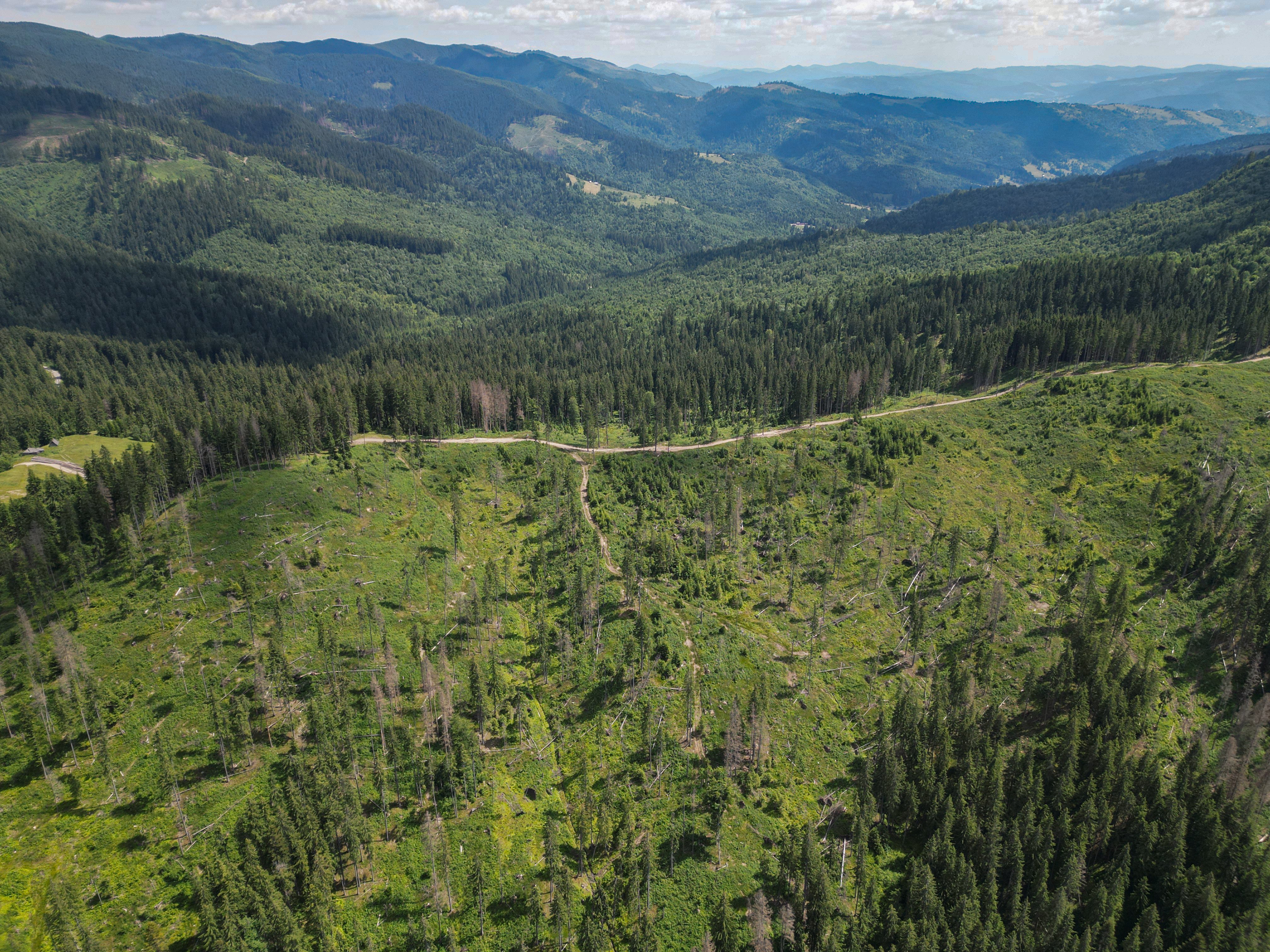
This aerial view taken on July 9, 2023 shows a former logging area in the Tarhaus Valley
This aerial image shows the central Transylvania region of Romania. Old-growth forests blanket the Carpathians, which span 1,500km (900 miles) across eight Central European nations. [Ionut Iordachescu/AFP]


  • About

    • About Us
    • Code of Ethics
    • Terms and Conditions
    • EU/EEA Regulatory Notice
    • Privacy Policy
    • Cookie Policy
    • Cookie Preferences
    • Accessibility Statement
    • Sitemap
    • Work for us
  • Connect

    • Contact Us
    • User Accounts Help
    • Advertise with us
    • Stay Connected
    • Newsletters
    • Channel Finder
    • TV Schedule
    • Podcasts
    • Submit a Tip
    • Paid Partner Content
  • Our Channels

    • Al Jazeera Arabic
    • Al Jazeera English
    • Al Jazeera Investigative Unit
    • Al Jazeera Mubasher
    • Al Jazeera Documentary
    • Al Jazeera Balkans
    • AJ+
  • Our Network

    • Al Jazeera Centre for Studies
    • Al Jazeera Media Institute
    • Learn Arabic
    • Al Jazeera Centre for Public Liberties & Human Rights
    • Al Jazeera Forum
    • Al Jazeera Hotel Partners

Follow Al Jazeera English:

  • facebook
  • twitter
  • youtube
  • instagram-colored-outline
  • rss
Al Jazeera Media Network logo
© 2026 Al Jazeera Media Network

You might also like:

live israeli attacks kill 76 no aid relief yet for... | thailand readies homecoming for stolen ancient sta... | russia ukraine war list of key events day 1185... | german woman arrested after mass stabbing at hambu... | vietnam orders ban on popular messaging app... | need answers will sri lankas tamils find war closu... | live israeli attacks kill 85 in gaza as starvation... | florida court orders ex mexican security chief to ...