Daughter of Venezuela’s Machado accepts Nobel Peace Prize on her behalf
In speech delivered by her daughter, opposition leader Maria Corina Machado says people must ‘fight for freedom’.
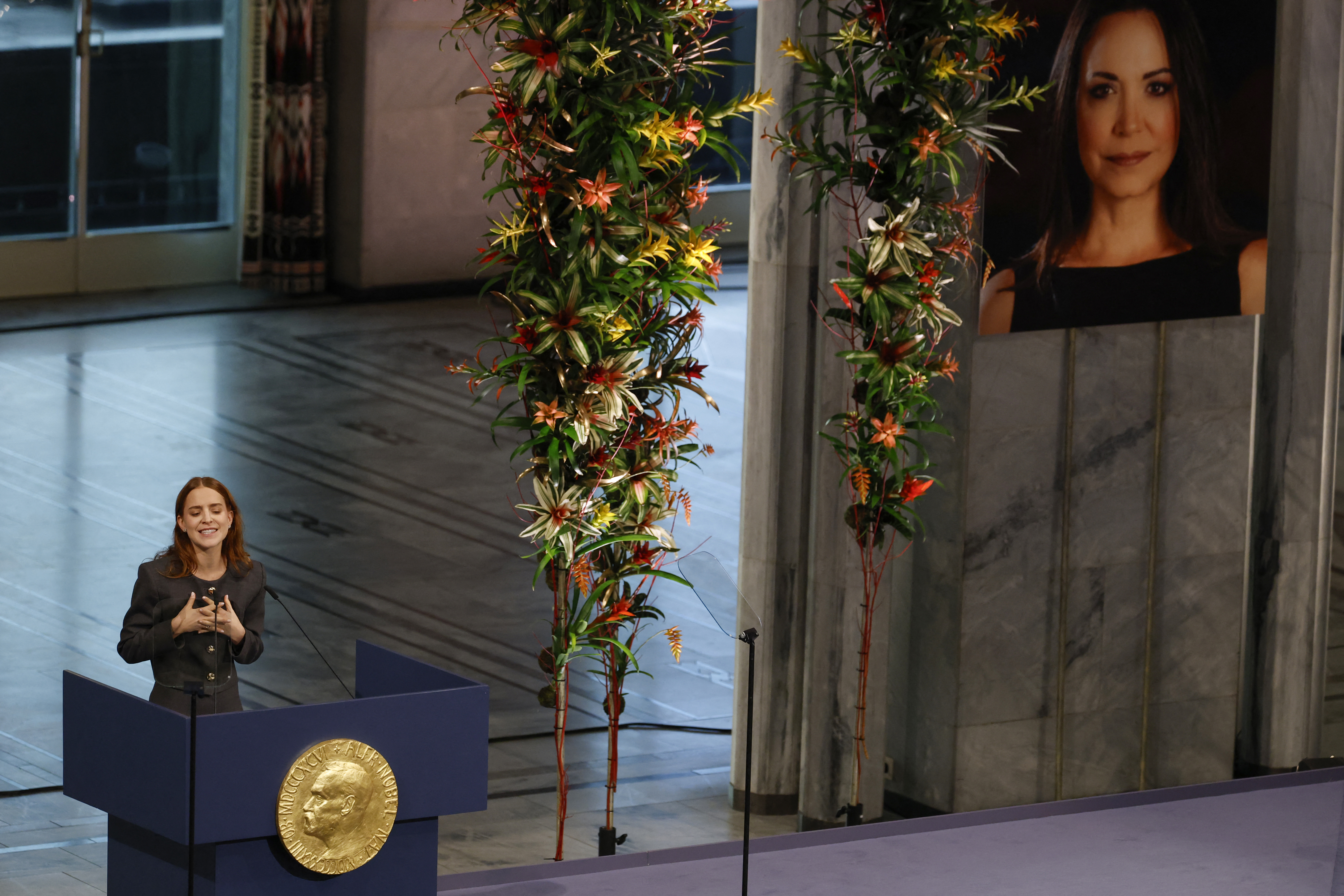
Venezuela’s opposition leader and Nobel Peace Prize laureate Maria Corina Machado has urged her country to fight for freedom against “state terrorism”, in a speech delivered by her daughter as she collected the prestigious award on her behalf.
Machado, who has spent more than a year in hiding due to threats to her life, was represented at Wednesday’s ceremony in Oslo City Hall by her daughter, after a cloak-and-dagger attempt to reach the Norwegian capital in time was unsuccessful.
Recommended Stories
list of 4 items- list 1 of 4Supporters of Venezuela’s Machado rally in cities around the world
- list 2 of 4How US pressure is squeezing Venezuela’s already fragile economy
- list 3 of 4Nobel Institute calls off Machado press conference ahead of award ceremony
- list 4 of 4The Take: US-Venezuela military buildup tests Puerto Rico’s painful past
In a blistering acceptance speech that slammed Venezuelan President Nicolas Maduro, Machado said that the prize held deep significance, both for her compatriots and the wider world.
“It reminds the world that democracy is essential to peace,” said Ana Corina Sosa Machado, delivering her mother’s words. “More than anything, what we Venezuelans can offer the world is the lesson forged through this long and difficult journey: that to have a democracy, we must be willing to fight for freedom.”
In the speech, Machado said Venezuelans had failed to realise in time that their country was sliding into what she described as a dictatorship.
“Freedom is a choice that must be renewed each day, measured by our willingness and our courage to defend it,” she said.
Machado, the 58-year-old leader of the Vente Venezuela party, was awarded the prize in October, with the Nobel Committee praising her role in the country’s opposition movement and her “steadfast” support for democracy.
At the time, the opposition leader, who holds many right-wing views, dedicated her prize in part to US President Donald Trump, who has said that he himself deserved the honour and was infuriated that he did not receive it.
Failed dash to Oslo
Machado, who has been in hiding since August 2024 after authorities expanded arrests of opposition figures following a disputed election, had secretly left Venezuela in an attempt to attend the ceremony.
“I will be in Oslo, I am on my way to Oslo right now,” Machado said in an audio recording released by the Norwegian Nobel Institute shortly before the ceremony, which was attended by Norway’s King Harald and three Latin American heads of state, including Argentina’s President Javier Milei.
It was unclear where she had made the call from.
Reuters reported that Machado, in defiance of a decade-long travel ban imposed by the Venezuelan government, had left her homeland by boat on Tuesday for the Caribbean island of Curacao, from where she left on a private plane bound for Oslo, citing a person familiar with the matter.
In 2024, Machado was barred from running in the presidential election, despite a landslide win in the opposition’s primary.
She went into hiding in August 2024 after authorities expanded arrests of opposition figures following the disputed vote in July 2024.
Speaking at the ceremony, Norwegian Nobel Committee head Joergen Watne Frydnes said it was “unfair” that fighters for democracy were expected “to pursue their aims with a moral purity their opponents never display”.
“No democracy operates in ideal circumstances. Activist leaders must confront and resolve dilemmas that we onlookers are free to ignore,” he said.
“People living under the dictatorship often have to choose between the difficult and the impossible.”
Alignment with right-wing hawks
The political leader has welcomed international sanctions and US military intervention in Venezuela, a move her critics say harkens back to a dark past.
The US has a long history of interference in the region, particularly in the 1980s, when it propped up repressive right-wing governments through coups, and funded paramilitary groups across Latin America that were responsible for mass killings, forced disappearances and other grave human rights abuses.
Venezuelan authorities cited Machado’s support for sanctions and US intervention when they barred her from running for office in last year’s presidential election, where she had intended to challenge Maduro. Machado has accused Venezuela’s president of stealing the July 2024 election, which was criticised by international observers.
While US sanctions have weakened Venezuela’s economy, its economic decline has also been partly due to its reliance on oil, as well as the country’s political volatility.
When Hugo Chavez came to power in Venezuela in 1999 and started what he called the Bolivarian Revolution – named after Simon Bolivar, the South American independence leader – he redirected oil revenues into social programmes that expanded access to housing, education, healthcare and military spending instead of going directly to the political elite via a patronage system.
While Chavez’s government initially reduced poverty and inequality, Venezuela’s unsustainable spending and deep reliance on oil – it has the world’s largest known oil reserves – left the country vulnerable. By the mid-2010s, an oil bust and tightening US sanctions spurred a full-out economic crisis in the country.
The crisis has only deepened since, as thousands emigrated away, and with half the population still living in poverty. The state of the country’s economy is among the many factors that have emboldened opposition leaders like Machado to push for new political leadership in Venezuela.
Shortly after her Nobel win in October, Machado also voiced support for Israel in a phone call with Prime Minister Benjamin Netanyahu, during Israel’s ongoing genocidal war in Gaza.
Machado has previously pledged to move Venezuela’s embassy in Israel to Jerusalem, as Trump did with the US diplomatic presence during his first term in office, if her movement comes to power. This would be on par with other right-wing Latin American leaders who have taken pro-Israel stances, including Argentina’s Milei and former Brazilian President Jair Bolsonaro.
Machado has aligned herself with right-wing hawks close to Trump who argue that Maduro has links to criminal gangs that pose a direct threat to US national security, despite doubts raised by the US intelligence community.
The Trump administration has ordered more than 20 military strikes in recent months against alleged drug-trafficking vessels in the Caribbean and off Latin America’s Pacific coast.
Human rights groups, some US Democrats, and several Latin American countries have condemned the attacks as unlawful extrajudicial killings of civilians.
Maduro, in power since 2013 following the death of Chavez, says Trump is pushing for regime change in the country to access Venezuela’s vast oil reserves. He has pledged to resist such attempts.
Venezuela’s armed forces are planning to mount a guerrilla-style resistance in the event of a US air or ground attack, according to sources with knowledge of the efforts and planning documents seen by the Reuters news agency.
