Spain high-speed train crash kills at least 40 as PM promises investigation
Emergency response teams deploy to assist victims after the high-speed train collision in southern Spain.
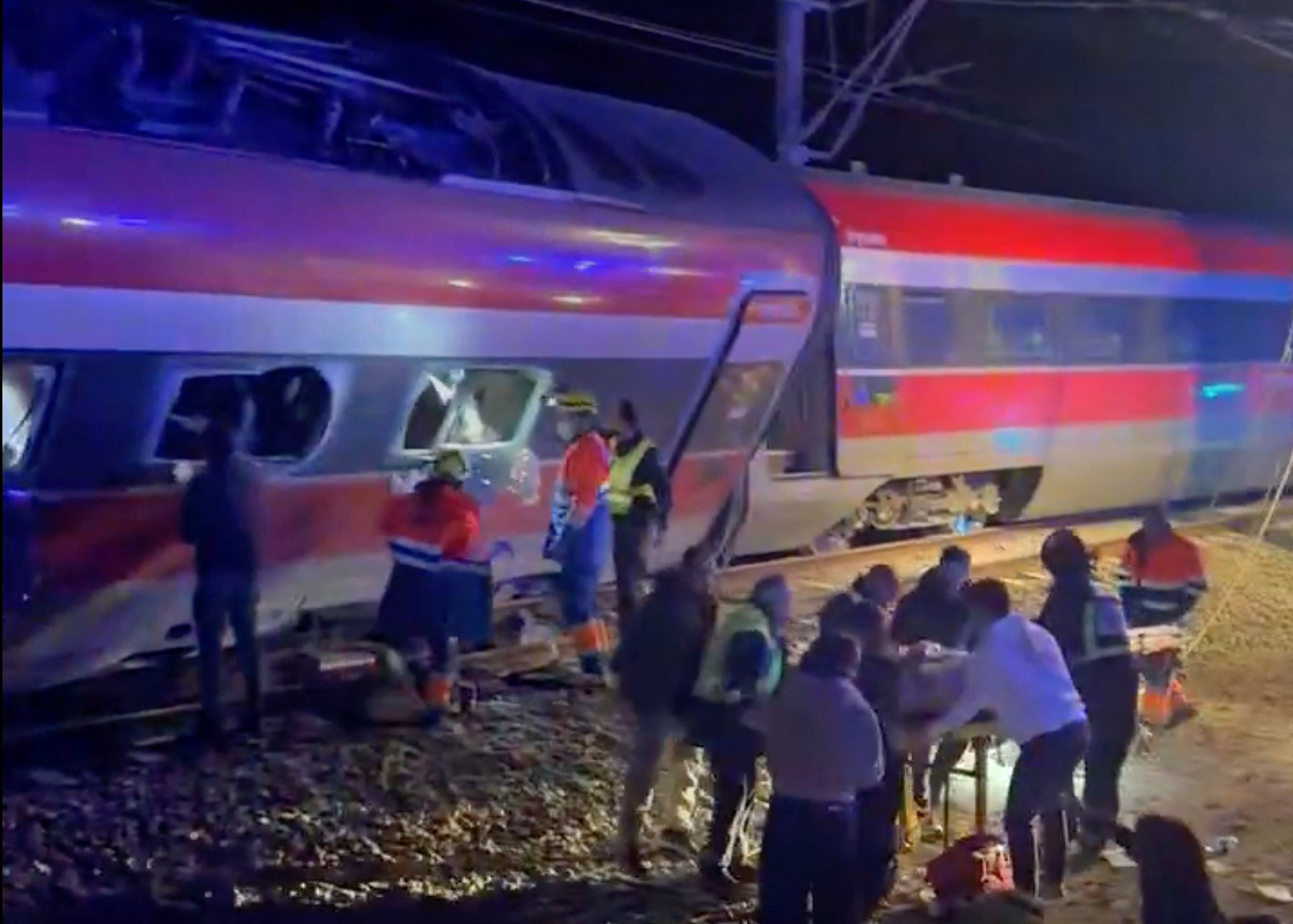

Spain is reeling from its deadliest train accident in more than a decade, with the death toll of a high-speed train collision rising to at least 40 people as emergency workers continue to search for victims and Spanish authorities promise an investigation into the accident’s causes.
The incident occurred when a train heading from Malaga to Madrid, with about 300 passengers on board, derailed near Cordoba in southern Spain at 7:45pm (18:45 GMT) on Sunday and collided with a train coming from the capital to Huelva, another southern city, carrying about 200 passengers.
Recommended Stories
list of 4 items- list 1 of 4Ten die as Greek fighter jet crashes in Spain
- list 2 of 4Van ploughs into Barcelona crowd killing at least 13
- list 3 of 4Libya mourns after army chief dies in plane crash near Turkiye’s capital
- list 4 of 4Train crash near Peru’s Machu Picchu kills driver, injures dozens
“We are wondering what happened. Time and the work of the experts will provide the answer,” Prime Minister Pedro Sanchez said during a news conference. “We will uncover the truth with absolute transparency and make it known to the public.”
Sanchez declared three days of national mourning, calling the incident a “day of sorrow for all of Spain”.
Details regarding the cause of the crash, the country’s deadliest since a 2013 derailment that killed 80 people in the northern region of Galicia, are still emerging.
Emergency services say that 12 people are in intensive care and 43 missing persons reports related to the incident have been filed at police stations in Huelva, Madrid, Malaga, Cordoba and Seville.
The updated death toll was confirmed by Juanma Moreno, the president of the Andalusia region, where the crash took place.
“Here at ground zero, when you look at this mass of twisted iron, you see the violence of the impact,” Moreno said. “The impact was so incredibly violent that we have found bodies hundreds of metres away.”
More victims may remain beneath the wreckage, which emergency workers with the heavy equipment necessary to lift it have struggled to access.
The Reuters news agency quoted Ana Garcia Aranda, a 26-year-old survivor of the incident, saying that she felt the train tip to one side before everything “went dark”.
“All I heard was screams,” said Aranda, who was being treated at a Red Cross centre in Adamuz.
Reports say initial investigation found a broken joint in the rails
Minister of Transport Oscar Puente told reporters at Atocha station in Madrid that it was “really strange” that a derailment should have happened on a straight stretch of track. The section of track was renewed in May, he said. Reuters reported that an initial investigation has found a broken joint on the rails.
“Thirty injured have been taken to hospitals and are in serious condition,” Puente told reporters on Monday, adding that all the injured have now been evacuated to receive care.
Alvaro Fernandez Heredia, the president of the state-owned rail operator Renfe, which ran one of the trains involved in the crash, said that human error has been “practically ruled out” as a cause.
Spanish train drivers’ union SEMAF had warned rail operator Adif in a letter in August of major wear and tear on high-speed rail tracks, including one involving the trains that collided last night, according to Reuters.
European Commissioner for Equality, Preparedness and Crisis Management Hadja Lahbib said the European Union was in contact with Spanish authorities and ready to help if asked.
Pope Leo XIV also offered his condolences, saying he was “deeply saddened” to hear of the crash and was sending his “heartfelt” condolences to the victims and their families.
Sanchez has cancelled a planned trip to Davos, Switzerland, for the World Economic Forum.
Television Espanola, a public broadcaster, reported that the driver of the train travelling from Madrid to Huelva was among those who died.
Five mobile intensive care units, four emergency critical care units and numerous ambulances were deployed to the site of the crash, according to Andalusia’s emergency services.
The on-site services were focused on stabilising the injured before transferring them to hospitals, Juanma Moreno, the president of Andalusia’s regional government, wrote on social media late on Sunday.
“Our solidarity and support to all those affected,” he added.
Authorities set up offices in several cities so relatives of victims can provide DNA samples to identify the deceased. A blood centre in Cordoba near the site of the crash said it has received a “large number of messages” from people offering to help and that blood reserves for Monday had been fully secured.

The Spanish broadcaster RTVE reported that the Madrid-Andalusia high-speed line, where the collision took place, will be closed at least until Friday.
Spain’s robust rail network and investment in high-speed trains have been a source of pride for the country. Its trains have served as a popular, competitively priced and largely safe form of transport.
“It’s a very popular network… It helps people connect and commute really quickly across the country, so it’s very popular,” journalist Lily Mayers told Al Jazeera on Monday from Madrid.
“This isn’t the first time Spaniards have experienced a tragedy of this size, but unfortunately, the death toll is continuing to rise this morning.”
