US-Israel war on Iran: What’s happening on day 25 of attacks?
Trump claims talks on with Iran, as he holds off on energy attacks, but Tehran denies any negotiations as US-Israel attacks on Iran, and Iran’s strikes on Gulf nations, continue.

Israel bombs petrol station in southern Lebanon

The war launched by the United States and Israel against Iran entered its 25th day on Tuesday, as conflicting claims emerged over possible peace talks.
US President Donald Trump said Washington was holding discussions with Tehran and suggested a broader agreement could be reached, but Iranian officials rejected the claims, accusing the US of trying to buy time as it deploys more forces to the region.
Recommended Stories
list of 1 itemend of listTrump also ordered the US military to postpone planned strikes on Iranian power plants and energy infrastructure for five days.
Meanwhile, Iran fired a new missile barrage at Israel, Gulf countries reported repeated drone and missile interceptions, and fighting intensified in Lebanon and Iraq.
Here is what we know:
In Iran
- New government appointments: Iran has named Mohammad Bagher Zolghadr as the new secretary of the Supreme National Security Council. He will replace Ali Larijani, who was killed in an Israeli-US attack on March 17.
- Latest attacks: Strikes on Iran by the US and Israel have left more than 82,000 civilian structures damaged or destroyed, the Iranian Red Crescent Society said on Tuesday.
- Trump’s ‘talks’: Trump claimed on Monday that discussions are ongoing with Iran to reach a broader peace agreement, stating that “Iran means business.”
- Iran’s denial: Iranian officials firmly rejected these claims, with the Islamic Revolutionary Guard Corps and parliamentary leaders calling the statements “fake news” and a “big lie”. Iranian officials have accused the US of fabricating these claims to manipulate global oil and financial markets, and to buy time as more US troops deploy to the region.
- US ultimatum: Over the weekend, Trump issued a 48-hour deadline for Iran to reopen the Strait of Hormuz. He threatened to “obliterate” Iranian power plants if Tehran failed to comply. On Monday, the deadline was extended for five days.
- US motivations and political pressures: Niall Stanage, a White House columnist for The Hill, suggests that Trump may be looking for an “exit ramp” because the war has been domestically unpopular and is causing significant economic pain, particularly through rising oil and fuel prices.
- Iranian suspicion and strategy: Reporting from Tehran, Al Jazeera’s Mohammed Vall noted that Iranian officials and state media are firmly projecting what he described as the “power of defiance”. Vall explained that Tehran harbours deep suspicion regarding any messaging from Washington, viewing Trump’s claims of peace talks as “manoeuvring” aimed at “winning time”.
- Iran arrests: Iranian authorities said that 466 people have been arrested, accused of seeking to destabilise the country through their online activity.
Diplomacy:
- Pakistani, Iranian leaders speak: Pakistani Prime Minister Shehbaz Sharif said he had spoken with Iranian President Masoud Pezeshkian on “the grave situation in the Gulf region”, and promised that Pakistan was committed to playing “a constructive role in advancing peace”.
- Pakistan willing to host peace talks: Pakistan’s Foreign Ministry spokesperson Tahir Andrabi told Al Jazeera on Tuesday that Islamabad is ready to host talks between the US and Iran for a negotiated settlement to the conflict.
- China FM encourages talks: China’s top diplomat told his Iranian counterpart in a phone call that “talking is always better than to keep fighting” after Tehran denied Trump’s claim that negotiations had taken place.
- UN rights meet: The UN Human Rights Council said it will hold an urgent meeting on Wednesday on Iran’s strikes on countries in the Gulf region.
In the Gulf
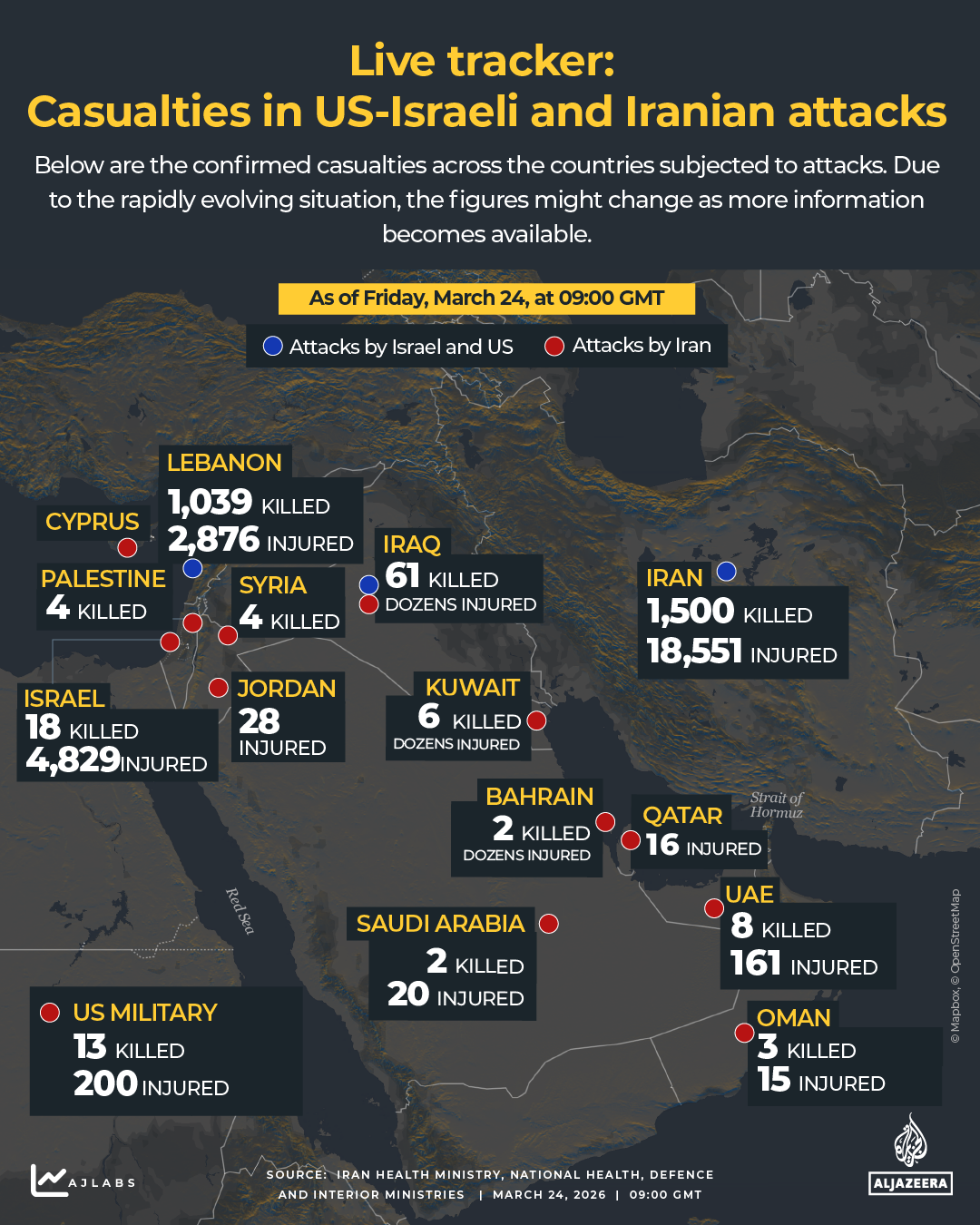
- Missile and drone interceptions in Kuwait: The country’s air defences responded to multiple incoming missile and drone attacks. Alarms were sounded at least seven times in a single night.
- Attacks targeting Saudi Arabia and Bahrain: Saudi Arabia intercepted approximately 20 drones targeting its Eastern Province, a critical region that houses the majority of the kingdom’s energy and oil facilities, on Monday. Additionally, Bahrain’s Ministry of Interior has sounded warning alarms numerous times over the past 24 hours. The country’s forces have intercepted 153 missiles and 301 drones since the start of the war.
- UAE says contractor killed: The UAE defence ministry said that a Moroccan contractor with the Emirati military was killed in Bahrain in an Iranian attack, with Manama saying the man had been assisting the local armed forces.
- Regional sentiment across the Gulf: Officials and civilians are pleading for dialogue and de-escalation. Qatar’s Foreign Ministry spokesperson Majed al-Ansari said diplomacy should be the path to ending the conflict, and the sooner warring parties get to the negotiating table, the better.
In the US
- Administration’s stance on Iran peace talks: Following Trump’s claims of having “productive” conversations with Tehran, the White House has pushed back against speculation regarding an imminent deal. White House press secretary Karoline Leavitt cautioned that the situation is “fluid” and stated that “speculation about meetings should not be deemed as final” until officially announced.
- President Trump’s approval rating drops: Trump’s approval rating has fallen to 36 percent, marking the lowest level since he began his second presidential term. A recent Reuters/Ipsos poll attributes this drop to the rising cost of living and growing public disapproval of the war with Iran.
- Threat level raised in Mauritania: The US Embassy in Mauritania has issued an elevated threat notice for US citizens and embassy staff due to a recent threat of “terrorist attacks”.
In Israel
- Missile strikes on Tel Aviv: Iranian missiles have impacted several areas of Tel Aviv, resulting in major building damage and at least four reported casualties.
- Israeli interceptor system malfunctions: A malfunction in Israel’s “David’s Sling” aerial interceptor system allowed two Iranian ballistic missiles to strike the south of the country, wounding dozens of people over the weekend, the military confirmed.
- Trump-Netanyahu call: Israeli Prime Minister Benjamin Netanyahu said he had spoken with Trump and that the US president believed the countries’ military gains in Iran could be converted into a negotiated agreement that protected Israel’s interests.
In Lebanon, and Iraq
- Israel attacks Beirut suburbs: An Israeli attack hit the Lebanese capital’s southern suburbs, hours after the Israeli army issued a warning for residents of the area to evacuate, saying it was “striking Hezbollah infrastructure in Beirut”.
- Israel’s “scorched-earth” policy: Israeli officials are reportedly pursuing a “Rafah model” in southern Lebanon, with the military instructed to demolish homes and villages near the border. The plan aims to completely depopulate the southern region, which makes up 10 percent of Lebanon’s landmass, and occupy it to create a buffer zone.
- Lebanon’s escalation: Al Jazeera’s Obaida Hitto, reporting from Beirut, described a “significant escalation” as Israel expands its ground operations and destroys vital infrastructure, such as bridges. Hitto stresses that this strategy is trapping civilians and making it “extremely difficult” for the Lebanese armed forces to deliver humanitarian aid to the more than one million people displaced by the war.
- First Iranian missile intercepted over Lebanon: An Iranian missile was intercepted over Lebanese airspace for the first time since the start of the US-Israel war on Iran.
- Lebanon recalls envoy from Tehran: Lebanon declared the Iranian ambassador to the country as ”persona non grata” on Tuesday and ordered him to leave the country. Lebanon has also summoned its envoy to Iran for consultations, citing what it described as Tehran’s violation of diplomatic norms and established practices between the two countries.
- Military strikes in Iraq: The US military launched a strike in Iraq’s Anbar province on the headquarters of an Iran-backed armed group. The attack was aimed at the group’s senior commander, Saad Dawai.
- Iraq’s battleground: Al Jazeera’s Nicolas Haque, reporting from Baghdad, characterised Iraq as a secondary battleground where the US and Iran-backed groups are “battling it out”. Haque noted that the US was engaging in “deliberate but calibrated targets” against leaders of the Iran-aligned groups, leaving the Iraqi people caught in the crossfire.
Oil, energy markets and Hormuz
- Stranded ships and South Korean turmoil: The closure has highly affected South Korea, which relies on the Middle East for more than 70 percent of its oil. The crisis forced the South Korean prime minister to cancel a trip to China to deal with the domestic economic fallout.
- Japan’s energy emergency: The situation is also dire for Japan, as nearly 95 percent of the country’s oil flows through the Strait of Hormuz.
- Philippines national energy emergency: Philippine President Ferdinand Marcos Jr has declared a “national energy emergency”, citing risks to domestic fuel supplies and energy stability created by the Iran war.
- Targeting Hormuz ‘economic terrorism’: The chief of the UAE’s state energy company ADNOC slammed Tehran’s blockade of the Strait of Hormuz, which has caused a surge in oil prices, as “economic terrorism against every nation”.
