How China’s ‘teapot’ refineries are cushioning it from Iran war oil crisis
Small independent refineries are helping China continue importing oil from Iran.

Iran’s paralysis of the Strait of Hormuz has continued to upend global oil and gas markets as the United States-Israeli war on the country enters its second month.
After US President Donald Trump pledged to continue aggressive strikes on Iran for another two to three weeks in a speech on Wednesday night, oil prices surged further.
Recommended Stories
list of 3 items- list 1 of 3After Strait of Hormuz opens, turmoil would still last months, analysts say
- list 2 of 3War on Iran: Three key takeaways from Araghchi’s interview with Al Jazeera
- list 3 of 3Oil price surges, Asian stocks fall as Trump vows to continue Iran attacks
Brent crude prices jumped about 5 percent to $106.16 per barrel on Thursday morning compared with Wednesday, when the price was $104.86 per barrel. Earlier this week, it surpassed $116.
Many countries have begun tapping into strategic oil reserves in a bid to ease the effects of an economic crisis.
But China appears to have largely insulated itself from the oil crisis, even though the country is heavily reliant on Iran for oil.
Here’s what we know.
Is China immune to the oil crisis?
Not entirely. China gets more than half of its oil from the Middle East, especially Iran. According to data from Kpler, China bought more than 80 percent of Iran’s shipped oil in 2025. China’s imports of Iranian crude were 1.4 million barrels of oil per day (mbd) in 2025, out of a total 10.4mbd seaborne crude imports.
When the US and Israel commenced strikes on Iran on February 28, and Tehran blocked the Strait of Hormuz through which about 20 percent of global oil and gas passes just hours later, Beijing was already prepared to cope with an energy crisis, as it had been preparing for years. In 2021, while visiting an oilfield in the country, Chinese President Xi Jinping stated that the country would take its energy supply matters “into its own hands”.
Since then, one of the key tactics the country has used to secure its oil supply is through “teapot refineries” – smaller, independent facilities which have capitalised on oil made cheap by international sanctions, stockpiling oil reserves and increasing imports from countries such as Iran, Russia and Venezuela. Indeed, until the US launched its strike on Caracas in January – capturing then-President Nicolas Maduro – and effectively seizing control of the Venezuelan oil industry, China was the largest buyer of oil from the country.
Muyu Xu, a senior crude oil analyst at Kpler, told Al Jazeera that China’s oil supply is not entirely immune to the ripple effects of the war in the Middle East, however.
“China’s seaborne crude imports in March stood at 10.19 million barrels per day (mbd), down from 11.51mbd in February, but still broadly in line with the 2025 average of 10.41mbd,” she said.
“However, most of the March arrivals were loaded before the war began in February. As Middle Eastern crude accounts for more than 50 percent of China’s total seaborne imports – and less than half of these barrels were able to reach the international market in March – China is expected to see a sharp decline in April arrivals.”
But Muyu noted that while China’s continued buying of Russian and Iranian crude has provided some buffer in this oil crisis, it will not be sufficient to offset the loss of non-Iranian supplies from the Middle East. “While our data shows that Iranian oil on water outside the Persian Gulf remains close to 165mb – equivalent to about four months of China’s Iranian imports – this does not mean China will rely on Iranian crude as a primary solution to ease the supply crunch,” she said.
While a large quantity of sanctioned Russian oil is being shipped to China on shadow fleets flying false flags, this is also likely to diminish as a result of the war after Trump relaxed US sanctions. Several Russian oil-laden tankers have already changed course on the open ocean to head for India instead.
Furthermore, teapot refiners cannot buy endless amounts of oil if prices rise substantially, Muyu said. “State-owned refiners remain concerned about compliance and operational risks, while teapot refiners are also holding back from new purchases due to high prices and thin margin.”
What are China’s ‘teapot refiners’?
They are small, privately owned oil refineries primarily based in China’s Shandong province, which are used by Beijing to import discounted Iranian and Russian oil to circumvent sanctions imposed by the US and other countries.
In a March 17 report for the Brussels-based economic think tank Bruegel, Alicia Garcia-Herrero, a senior fellow at Bruegel and chief economist for Asia Pacific at Natixis, wrote: “To avoid the reputational and financial risk from importing sanctioned [Iranian] oil, this oil was mainly bought by small, private ‘teapot’ refineries, rather than major Chinese state-owned oil companies.”
She noted that Iranian oil was also paid for in renminbi through China’s new Cross-border Interbank Payment System (CIPS).
These refineries are known as “teapots” because of their compact teapot-like shape. They account for one-quarter of China’s processing capacity – but they operate on very narrow margins, meaning they are very sensitive to fluctuations in the price of oil.
According to the Oxford Institute for Energy Studies, these refineries came to be known globally in July 2015, when Chinese crude buying surged.
“In normal times, they [the teapots] boost fuel supply and margins. During crises, they act as a flexible buffer for bargain barrels. However, when discounts dry up and prices surge, their thin profit margins get squeezed, forcing some to cut operations,” Garcia-Herrero told Al Jazeera on Thursday.
The US has previously imposed sanctions on some of these teapot refineries – such as the Hebei Xinhai Chemical Group refinery in the Shandong province in May last year – for importing Iranian oil.
“The United States remains resolved to intensify pressure on all elements of Iran’s oil supply chain to prevent the regime from generating revenue to further its destabilising agenda,” Treasury Secretary Scott Bessent said in a statement at the time.
Alejandro Reyes, adjunct professor at the Department of Politics and Public Administration at the University of Hong Kong, told Al Jazeera that China did not so much create teapots to operate as “sanctions sponges”, but rather has tolerated an independent system that has proved strategically useful to it.
“These smaller independent refiners handle discounted and politically risky crude, while major SOEs [state-owned enterprises] remain more insulated. US sanctions actions in 2025 and 2026 show that Washington sees that strategy and structure clearly,” he said.
“The resilience is intentional at the system level, even if every single instrument within it was not originally built for this exact crisis. China’s energy architecture now gives it optionality, redundancy and some plausible deniability,” he added.
How are the teapots helping China amid the war on Iran?
These teapot refineries have been keeping the Chinese economy stable with imported Iranian and Russian oil, while big Chinese oil firms like Sinopec push for permission to draw on the country’s strategic oil reserves, rather than import Iranian oil themselves amid the war. However, teapots will not be able to make up the difference for long.
Most of their current oil stocks were bought before the war started.
“We built some inventories earlier, so the pressure is not that big for the near term,” a Shandong teapot executive told the Reuters news agency.
According to Oilchem, a consultancy firm which provides information on China’s commodity market, in the week ending March 5, Shandong teapot refineries were operating at 54.58 percent of capacity, up by 2.89 percentage points compared with the week before. As the war continues to rage, experts say the teapots continue to feel the pressure.
Now, due to the war, Garcia-Herrero wrote in her March 17 report, “teapot refineries have lost access to low-cost crude and face high replacement prices in a market already strained by global tensions”.
What else can China do to cushion itself from the oil crisis?
Besides allowing private teapot refineries to import quantities of Russian and Iranian oil, Beijing has also resorted to stockpiling its own official oil reserves, rerouting supplies and relying more heavily on sanctioned Russian oil, in particular, to cushion the impact of the war.
Stockpiling sanctioned oil
On March 31, the US House Select Committee reported that despite Western sanctions on oil produced by countries like Russia, Iran and Venezuela, China has continued buying from these countries, and this has helped it stockpile oil reserves.
“From this sanctioned crude, China assembled a massive strategic petroleum reserve – roughly 1.2 billion barrels by early 2026, equal to approximately 109 days of seaborne import cover – at well below market cost from the very barrels Western sanctions were designed to strand,” the committee stated in its report.
The report added that shadow fleets – networks of older oil vessels which generally have no insurance – and sanctioned tankers transported about 10.3mbd last year, with about one-third going to China.
“Chinese companies are often using the notorious shadow fleet: ageing, frequently uninsured tankers that switch flags, go dark on tracking, or perform ship-to-ship transfers to dodge sanctions and price caps. This dark fleet lets Beijing secure cheap energy while giving sanctioned producers like Russia and Iran a vital revenue stream,” Garcia-Herrero said.
“It [China] remains a major buyer of Russian oil, with volumes spiking as Middle East tensions rose in early 2026,” she added.
According to Chinese customs data, in the first two months of 2026, Russia’s shipments of crude oil to China rose by 40.9 percent.
Getting around the Iranian Hormuz blockade
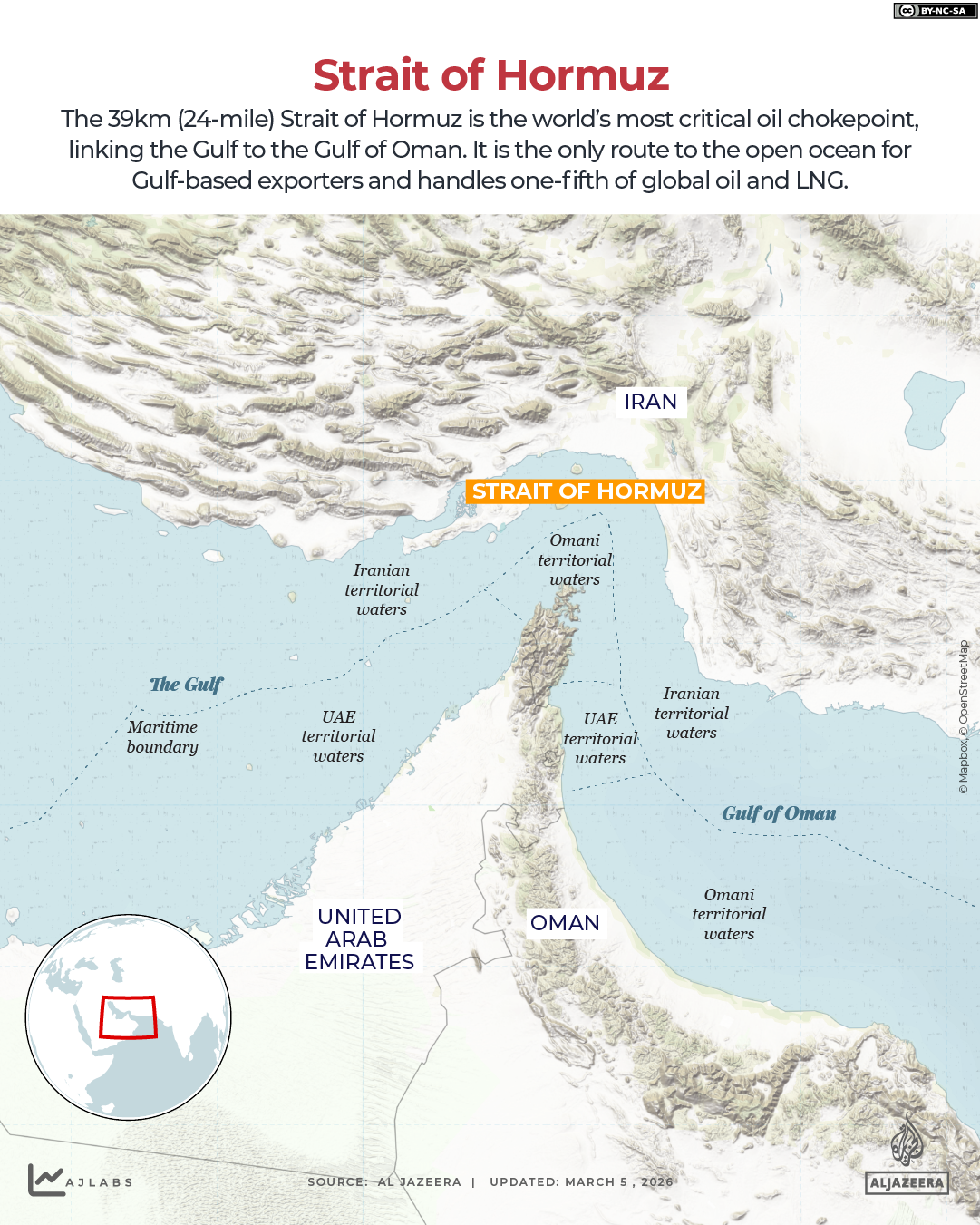
Iran, whose territorial waters extend into the strait, has blocked the passage of the vast majority of vessels carrying oil and liquefied natural gas (LNG) from the Gulf to the rest of the world since the US and Israel launched the war on February 28.
The move sent the price of Brent crude – the global benchmark – soaring well above $100 per barrel, a jump of roughly 40 percent from before the war. Many countries, particularly in Asia, have been forced to ration fuel and cut industrial production. On Thursday, Malaysia ordered civil servants to work from home in order to preserve fuel and guard against rising energy costs.
Affected countries in Asia, many of which rely heavily on supplies of oil and natural gas through the Strait of Hormuz, have been scrambling to make deals with Iran for safe passage through the only sea route Gulf producers can use to ship oil and gas.
On March 4, Chinese Foreign Ministry spokesperson Mao Ning told reporters: “Energy security is of great importance to the global economy … China will take necessary measures to ensure its energy security.”
In mid-March, Iran began allowing some Iranian vessels and a handful of ships from countries Iran deems friendly, such as Malaysia, China, Egypt, South Korea, India and Pakistan, to pass as well.
On March 31, a Chinese Foreign Ministry spokesperson told reporters that three Chinese ships had sailed through the strait.
China has also diversified oil imports by increasing the amount it imports by pipeline from Russia, Garcia-Herrera said.
Meanwhile, about 2,000 other ships wait at either end of the strait for permission from Iran to do the same.
“Beijing’s approach of aggressive stockpiling, tolerating shadow networks, and keeping flexible buffers shows it has long prepared for exactly these kinds of energy shocks,” Garcia-Herrero said. While these measures will not completely immunise the country from rising fuel prices, it does give Beijing more flexibility to survive a crisis compared with other nations.
“China is turning geopolitical turbulence into discounted oil and strategic depth, while the shadow fleet keeps the barrels flowing,” she said.
“It’s classic great-power energy chess.”
