Israeli attacks kill 14 in Lebanon as Pentagon hosts security talks
Israeli forces advance across Lebanon’s Litani River as Lebanese and Israeli military delegations meet in the US.
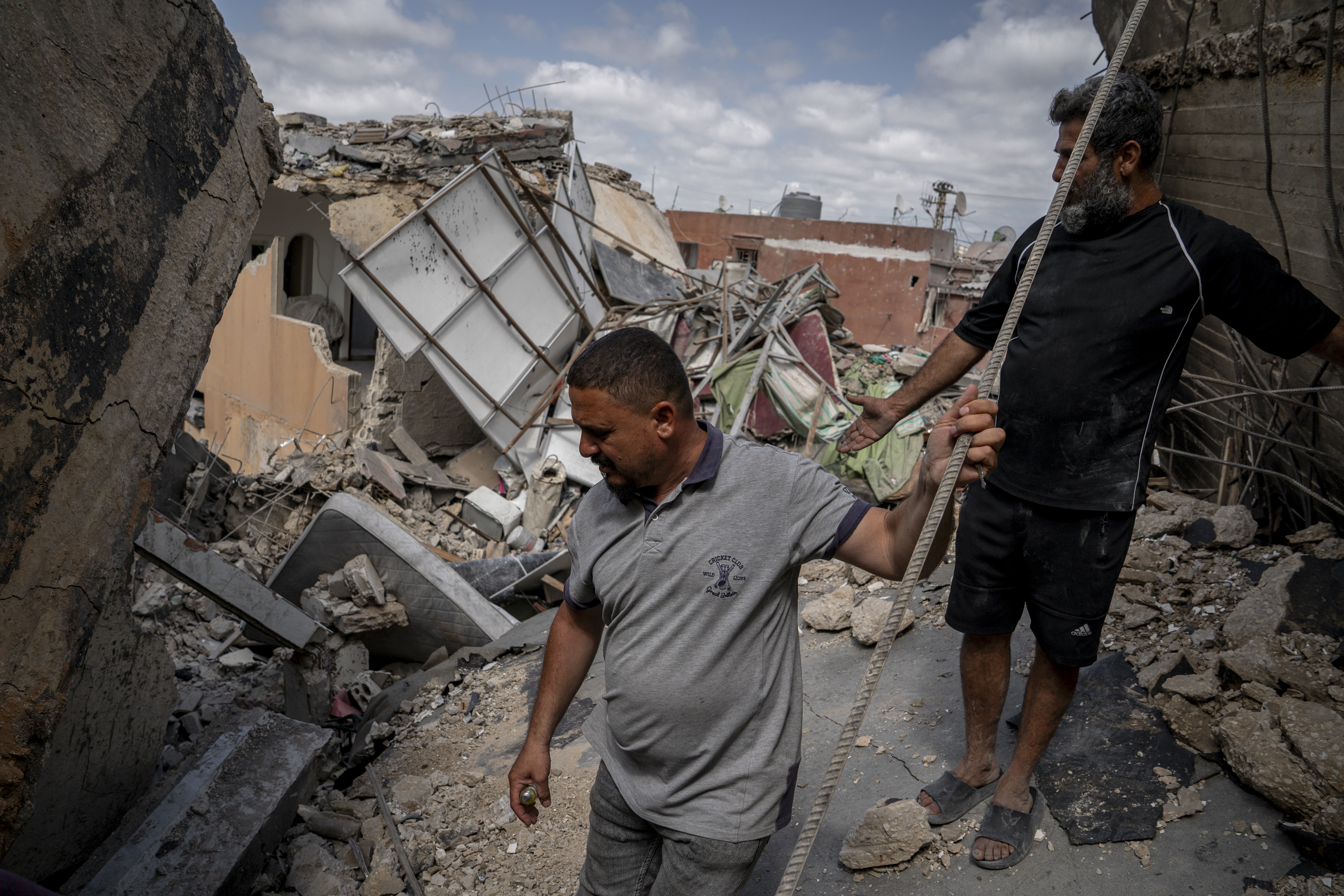
At least 14 people have been killed in Israeli air strikes targeting towns in southern Lebanon, according to state-run media, as Lebanese and Israeli military delegations hold security talks at the Pentagon.
The attacks on Friday came as Prime Minister Benjamin Netanyahu said Israeli forces had crossed the Litani River in Lebanon, which runs about 30 kilometres (about 19 miles) north of their shared border, in an expanded ground offensive.
Recommended Stories
list of 4 items- list 1 of 4How War Changed Eid in Lebanon
- list 2 of 4US and Iran reach tentative deal for 60-day truce extension, officials say
- list 3 of 4US-Iran 60-day proposal: What we know
- list 4 of 4Harvard Medical School graduate dedicates speech to Lebanon and Palestine
Israel’s latest military operation started despite the “ceasefire” that began on April 17, and was extended for 45 days on May 17 following indirect talks mediated by the United States.
Israel-Lebanon talks
At the Pentagon talks on Friday, Lebanon was expected to demand that Israel halt its ongoing attacks, which have intensified in recent days.
The Lebanese delegation includes six officers, headed by the army’s director of operations, Georges Rizkallah.
On the Israeli side, Brigadier General Amichai Levin, head of the strategic division within the army’s planning directorate, is in Washington for the talks, according to an Israeli military spokesperson.
Lebanese President Joseph Aoun told US Secretary of State Marco Rubio that a ceasefire with Israel was crucial. A statement from his office said that during a phone call, Aoun “emphasised the need to exert all efforts to reach a ceasefire, considering it an essential gateway to moving on to any other step”.
Rubio reiterated the US administration’s commitment to consolidating the outcomes of previous ambassador-level negotiations between Israel and Lebanon in Washington, and expressed his support for Lebanon’s stability, independence and sovereignty, the statement added.
Spokesperson for the US Department of State, Tommy Pigott, told reporters that during the call, Rubio commended Aoun’s “courage and vision in pursuing direct negotiations with Israel”.
Rubio said Hezbollah is “entirely responsible for the ongoing fighting” and emphasised the need for the armed group to immediately cease its attacks.
‘Eleven children killed, injured every 24 hours’
In Friday’s attacks on southern Lebanon, four people were killed in an Israeli strike on a building in the town of Abbasiyeh, near the city of Tyre, according to the National News Agency (NNA). Another person was killed in a separate strike on Deir Qanoun en-Nahr, NNA reported.
Attacks on the al-Harthiyeh area on the outskirts of the town of Adloun in Lebanon’s Sidon district killed eight Syrians.
And earlier on Friday, a Lebanese police officer was killed in an Israeli drone strike on the town of Aba in Nabatieh province.
NNA said Israeli forces also carried out a new series of air raids on the towns of as-Sarafand and Khirbet Selm. Israeli warplanes also targeted a house in the town of Harayib, leaving several people injured. And Israel carried out more strikes that hit the towns of Gandouriyeh, Froun, and al-Mansouri in southern Lebanon.
Fifteen children have been killed in Lebanon and 62 injured over the last seven days, the United Nations said.
The UN children’s agency, UNICEF, called the figures “staggering”, and stressed that, under international humanitarian law, children have to be protected at all times during conflict.
“According to the Lebanese Ministry of Public Health, 77 children have reportedly been killed or injured over the past week alone,” UNICEF spokesperson Ricardo Pires told a media briefing in Geneva.
“Fifteen children killed and 62 injured in seven days. That’s an average of 11 children every 24 hours. We understand the vast majority of these children were impacted by air strikes in south Lebanon. Only yesterday, seven children were killed and 30 injured,” he added.
A humanitarian catastrophe
Several aid organisations fear they may have to pull out of southern Lebanon because of relentless attacks.
Hundreds of thousands of Lebanese have been forced from their homes by Israel’s military since March 2, and require urgent humanitarian assistance.
“If the security situation continues to deteriorate, we might have to leave certain areas. There are certain red lines we cannot cross for the security of our teams,” Jeremy Ristord, with medical NGO Doctors Without Borders, known by its French initials MSF, told Al Jazeera.
About 40 hospitals in the south are already closed, he noted.
“On top of that, rescue teams are already working under intense strain in adapting their interventions in the face of the degrading security situation,” said Ristord, noting that rescuers fear “double-tap strikes” by Israel.
“Sometimes, they’re not even able to intervene.”
He noted that 126 civil defence workers have been killed and 310 wounded in the war since March – “that’s four casualties a day.”
Israeli military ‘heavily bombarding’ Hezbollah
Also on Friday, the Israeli military issued forced displacement warnings for an additional seven towns in southern Lebanon, two of them about 40 kilometres (25 miles) north of Israel.
The Israeli prime minister visited troops near the border, according to a video released by his office.
There, he said that Israeli forces had crossed Lebanon’s Litani River and advanced, and that they were also operating in Beirut and the Bekaa Valley as part of actions against Hezbollah across the Lebanese front.
“Netanyahu made a surprise visit to the Lebanese border on Friday, confirming that Israeli troops are now positioned north of the Litani River; there has been a focus of Israeli firepower … throughout Nabatieh district,” said Al Jazeera’s Obaida Hitto, reporting from Tyre in Lebanon.
Israeli troops have broken through Hezbollah’s second lines of defence, and are now “heavily bombarding” the armed group’s third lines of defence, Hitto added.
