Israel, Lebanon agree to conditional ceasefire
Deal is made through US-brokered talks in Washington, DC, that did not include Hezbollah.
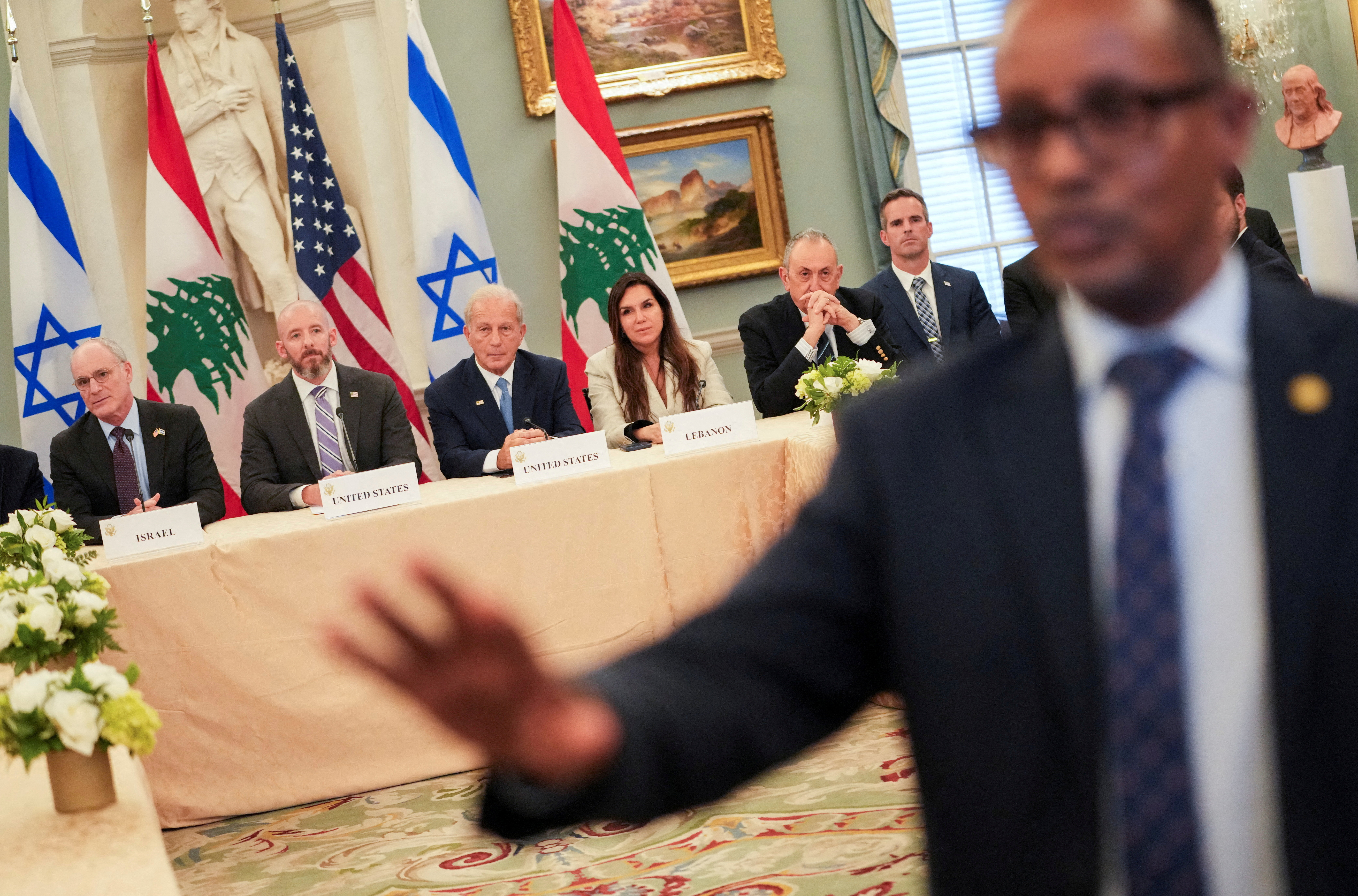
Israel and Lebanon have agreed to implement a ceasefire that would require a “complete cessation” of fire by Hezbollah, according to a joint statement after US-led talks in Washington, DC.
The two countries, which do not have formal diplomatic relations, also agreed on Wednesday to create “pilot zones”, in which the Lebanese armed forces “will take exclusive control of the territory to the exclusion of all non-state actors”.
Recommended Stories
list of 4 items- list 1 of 4Netanyahu downplays US-Israel rift after Trump confirms criticism
- list 2 of 4Israeli attacks kill nine in Lebanon, reach Beirut outskirts
- list 3 of 4Israel’s decades-long history of invading Lebanon
- list 4 of 4Trump seeks to split Lebanon talks from war on Iran negotiations
The development came despite continued cross-border attacks earlier in the day as Hezbollah said it targeted Israeli soldiers and Israeli strikes killed at least 10 people in southern Lebanon.
Just hours after the agreement was announced, air raid alarms were reported in northern Israel with a “suspicious aerial target” identified, but no casualties were reported.
A joint statement said the ceasefire was “contingent on a complete cessation” of fire by Hezbollah as well as the removal of the group’s operatives from southern Lebanon.
“This is not the announcement of a brand-new ceasefire; this is asserting respect for a ceasefire that was actually agreed just last month in May, which was a 45-day extension to an already existing ceasefire that was there before,” Al Jazeera’s Manuel Rapalo said, reporting from Washington, DC.
“The fact that Hezbollah, as a group, has not been part of this negotiation makes them kind of a wild card and leaves questions unanswered as to how any sort of framework that could result from these negotiations would be implemented,” he added.
Hezbollah’s official response pending
A Hezbollah official told the AFP news agency on Thursday that the group had informed Lebanese authorities that it had rejected the ceasefire.
The official said on condition of anonymity that the position, which was announced by Hezbollah chief Naim Qassem in a televised message, was passed on Parliament Speaker Nabih Berri, a Hezbollah ally acting as an intermediary who “shares this position”.
Lebanese President Joseph Aoun had said earlier on Thursday he was waiting for Hezbollah’s response.
The meetings in Washington were the fourth round of direct talks between Lebanese and Israeli diplomats since fighting escalated on March 2 when Hezbollah renewed attacks against Israel in support of Iran, which led to intensified Israeli bombardments and a ground invasion of southern Lebanon.
Both sides will meet for more talks the week of June 22, the statement said, “with a view towards reaching a comprehensive agreement”.
However, Israeli Defence Minister Israel Katz said on Thursday that the country’s military will continue to carry out operations in Lebanon for the time being and will not be withdrawing from the country, despite the announcement of the new ceasefire.
Hundreds of thousands of Lebanese residents, forced from their homes in the south by Israel’s military since fighting began in March, would also not be allowed to return, he said in a statement.
Israel would also continue to “dismantle terrorist infrastructure in the area” and had “freedom of action, backed by the United States, to strike in Beirut in response to attacks on Israeli communities and territory” Katz said.
Civil Defence authorities in Lebanon have asked people not to return south despite the ceasefire announcement, citing ongoing dangers and the risk of unexploded ordnance in towns and villages.
Aoun described the latest ceasefire negotiations as difficult, warning that the agreement represents a “last opportunity”.
“The results of the fourth round of negotiations, and the statement issued from it, which included very important points in Lebanon’s favour, represent the last chance to enter into a final, comprehensive ceasefire. Each party bears responsibility” if it fails to respond positively, Aoun said on Thursday, according to a statement from his office.
Lebanese Prime Minister Nawaf Salam said on Thursday that the army would begin deploying in “pilot zones” in the country’s south “as a first phase”.
According to remarks read out by Information Minister Paul Morcos after a cabinet meeting, Salam added that “this does not prejudice our right to a full [Israeli] withdrawal, but brings us closer to it”.
Meanwhile, the head of the Quds Force, the foreign arm of Iran’s Islamic Revolutionary Guards, said that Israel must pull back from its current front lines in Lebanon to the lines before the war on Iran started.
“Supporting the resistance in Lebanon is the duty of all of us, and removing Israel from the region is an attainable goal for Muslims,” Esmail Qaani said in a post on a domestic social media platform on Thursday.
“The minimum demand of the resistance is the withdrawal of the usurping regime [Israel] to the position it held before the start of the 40-day war.”
Ziad Majed, a professor of Middle East studies at the American University of Paris, told Al Jazeera it is difficult to see the ceasefire actually holding.
“The Israelis are interpreting the agreement as just another one to allow them to continue their attacks. … They’re not talking about withdrawal from the occupied land. So I think there are risks,” he said.
But Majed noted Hezbollah faces internal pressure “within its own social bases” to make the truce work.
Iran’s reaction
Earlier in the day, United States President Donald Trump said he wanted to separate talks on the conflict in Lebanon and those on the US-Israeli war on Iran.
Tehran, however, insists the conflicts are linked, and its foreign minister, Abbas Araghchi, warned that any attack on Beirut would trigger a “full-scale resumption” of war.
The Tasnim News Agency quoted Araghchi as telling Lebanon’s Al Mayadeen TV on Wednesday that lines of communication with the US were still open but “no tangible progress” has been made in negotiations to end the Middle East war.
Separately, Iran’s Supreme Leader Mojtaba Khamenei said in a message on Thursday that Iran’s enemies, having been defeated on the battlefield, were now seeking to undermine public resilience and sow internal divisions in a message read on his behalf during ceremonies marking the anniversary of the death of Iran’s founder, Ruhollah Khomeini, as well as a major Shia holiday.
At least three people have been killed and four injured in an Israeli strike on the town of Sohmor in Lebanon’s Bekaa Valley on Thursday, the state-run NNA news agency reports.
A separate strike also hit Tell al-Aqareb, north of Sohmor, despite a ceasefire having been agreed between Israel and Lebanon.
Additional raids also hit the southern Lebanese towns of Haddatha, Tibnin, Haris, Kfar and Harin.
The Israeli military said late on Thursday that one of its soldiers was killed in southern Lebanon, the first since the announcement of the conditional ceasefire.
A truce to halt the fighting in Lebanon was meant to take hold on April 17 but has never been observed. Both sides have justified their attacks with the other’s alleged violations.
